Echizen Oroshi Soba in Takefu: How to Eat It and Where to Try the Local Set Meals
Short answer: Echizen oroshi soba (越前おろしそば) is Fukui’s signature noodle dish: cold buckwheat noodles topped with grated daikon radish, bonito flakes and green onion, with the broth usually poured over rather than used for dipping. Takefu, the old town at the center of Echizen City, has a good claim to it: Japan’s Ministry of Agriculture says soba in noodle form came to the area in 1601, when the lord of Fuchu (today’s Echizen City) brought soba makers from Kyoto-Fushimi. Echizen City counts oroshi soba as one of its three local dishes, along with Volga rice and Takefu ekimae chuka soba, and ten local restaurants serve them together as a set. Most of them are within walking distance of Takefu Station on the Hapi-Line Fukui.
A note on sources: we have not eaten at any of these restaurants, so this guide does not rate them. It is based on a brochure from the Echizen City Tourism Association that we picked up in Takefu on November 1, 2026, and on official pages from Japan’s Ministry of Agriculture, Forestry and Fisheries and from Discover Fukui (the Fukui Prefectural Tourism Association’s English site). The brochure says its prices are as of mid-June 2025 and that set menus may end without notice, so we don’t list prices, and you should check before you go.
What Echizen oroshi soba is
The Ministry of Agriculture describes Echizen soba as darker than most soba and known for its sweetness and strong aroma. Fukui’s buckwheat grains are small, and millers in the prefecture grind them slowly with millstones. Some grind the outer husk in with the grain, which is part of why the noodles look darker.
The oroshi (grated) part is the radish. Discover Fukui says that in the northern half of the prefecture the most common way to eat soba is cold, topped with spicy grated daikon. The ministry notes that a spicy radish is used depending on the season. The usual toppings are grated daikon, shaved bonito (katsuobushi) and sliced green onion.
How to eat it
- Pour, don’t dip. The ministry says the broth is either used for dipping or poured over the noodles, and pouring is the Echizen oroshi soba style.
- Ask for sobayu at the end. Discover Fukui suggests asking for sobayu, the warm water the noodles were cooked in, and pouring it into the broth left in your bowl to drink.
- November is new-soba season. The ministry gives November as the buckwheat harvest, with new-soba festivals around the prefecture.
A short history
The ministry’s account starts in 1471, when the Asakura clan grew fast-ripening buckwheat at Ichijodani as a food store for sieges. At that time it was eaten as a dough or dumplings, not noodles. According to the ministry, noodles arrived in 1601, when Honda Tomimasa, lord of Fuchu, brought soba makers from Fushimi in Kyoto, and this led to oroshi soba. Fuchu is the old name for the center of present-day Echizen City, where Takefu Station is.
Echizen City’s three local dishes
The tourism association’s brochure presents three dishes as the ones locals love most:
| Dish | What it is (per the brochure) |
|---|---|
| Echizen oroshi soba (越前おろしそば) | Soba with grated daikon; the brochure calls it Fukui’s soul food |
| Volga rice (ボルガライス) | An omelette over rice, topped with a pork cutlet and sauce; eaten locally for more than 30 years |
| Takefu ekimae chuka soba (たけふ駅前中華そば) | A plain, old-style ramen built on the soba shops’ dashi (broth) |
“Ekimae” means “in front of the station”, and “chuka soba” here means ramen, not buckwheat noodles. Discover Fukui adds that Volga rice was created in Takefu and that recipes vary from shop to shop.
The “Himitsu” set: all three in one meal
The brochure is a guide to the ひ三つのごちそうセット (Himitsu no Gochisō Setto). Himitsu means “secret”, and the 三つ in the middle is the word for “three”. There are four combinations:
| Set | What’s in it |
|---|---|
| Trio (トリオ) | Oroshi soba + chuka soba + Volga rice |
| Combi A (コンビA) | Oroshi soba + chuka soba |
| Combi B (コンビB) | Oroshi soba + Volga rice |
| Combi C (コンビC) | Chuka soba + Volga rice |
The four shops that serve the Trio also serve the Combis. The other six serve one Combi each. Every set except Combi C includes oroshi soba, so the soba is the common thread.
The ten restaurants
Walking times are the brochure’s and are counted from Takefu Station on the Hapi-Line Fukui, not from Echizen-Takefu Station on the Shinkansen (see “Getting there” below). The closing days are as printed in the brochure (mid-June 2025); check them before you go.
- Edoya (越前めん処 江戸屋), Trio: Mills its own flour from Imajo’s native buckwheat; the chuka soba uses Fukui wheat and Echizen City bamboo shoots; Volga rice with a Japanese-style sauce. No sets at breakfast. Getting there: 20 min walk. Closed (per brochure): Mon, 1st and 3rd Tue.
- Iseya (麺房 いせや), Trio: Founded in the late Edo period; firm noodles and a spicy radish; garlicky chuka soba; a Volga rice sauce topped up over the years. Getting there: 9 min walk. Closed (per brochure): Thu.
- Rokube (ろくべえ), Trio: Set meals and an izakaya menu, with private rooms in several sizes. Getting there: 3 min by car from the Takefu interchange. Closed (per brochure): Wed.
- sobar’s (ソバーズ), Trio: A bar with live music by local bands; hand-made soba from Fukui flour and a spicy Volga rice. Evenings only. Getting there: 1 min walk. Closed (per brochure): Sun, irregular.
- Yamamuro (越前そば うどん坊 山むろ), Combi A: Known for its chuka soba; the set comes with a fried sweet bun (agekarintō manjū). Getting there: 8 min walk. Closed (per brochure): Wed, 3rd Tue (Tue lunch only).
- Shōzakaiya (そば処 庄境屋), Combi A: Founded about 200 years ago, now run by the seventh generation; coarse-ground Echizen City buckwheat; set comes with soba dumplings. Lunch only. Getting there: 9 min walk. Closed (per brochure): Thu.
- Takimasa (和風レストラン 瀧雅), Combi B: A large Japanese restaurant (about 400 seats); house-made nihachi soba (80% buckwheat); barrier-free. Getting there: next to the Takefu interchange. Closed (per brochure): irregular days and the New Year holidays.
- Iroha Honten (いろは本店), Combi B: A family diner in front of the station since 1929; soba made with local spring water. Getting there: 4 min walk. Closed (per brochure): Wed.
- HAMA-an (越前そばと珈琲 HAMA庵), Combi B: 100% buckwheat (juwari) soba with a rich white dashi; Volga rice cooked in an iron rice pot, with two sauces. Getting there: 8 min walk from Takefu-shin Station (Fukui Railway). Closed (per brochure): Tue.
- Echizen Soba no Sato (越前そばの里), Combi B: Grows its own buckwheat and does everything from milling to the broth; the Volga rice is topped with Fukui’s sauce katsu; soba-making classes and a shop. On weekdays the set is served until 2 p.m.. Getting there: 2 min by car from the Takefu interchange. Closed (per brochure): Jan 1–3 (no sets Dec 28–31).
If you only want the soba, any of these shops serves oroshi soba on its own as well.
Which one for you?
- Near the station, on foot: Iroha Honten, Yamamuro, HAMA-an, Iseya and Shōzakaiya are all within about 10 minutes of Takefu Station.
- Soba as the main event: Shōzakaiya (an old soba shop, coarse-ground local buckwheat), Edoya (mills its own native buckwheat) and HAMA-an (100% buckwheat).
- Watch or make soba: Echizen Soba no Sato, which Discover Fukui also lists for soba-making classes (booking needed).
- In the evening: sobar’s opens only in the evening, and Rokube is open into the night. Iseya lists early-evening hours but asks you to book. Several of the others close in the afternoon.
- Groups or step-free access: Takimasa and Echizen Soba no Sato are large and listed as barrier-free.
Getting there
Takefu has two stations, and they are not next to each other:
- Takefu Station (武生駅, Hapi-Line Fukui): the old town station. Most of the restaurants above are around it. The Hapi-Line Fukui is the local line that runs between Tsuruga and Fukui and beyond.
- Echizen-Takefu Station (越前たけふ駅, Hokuriku Shinkansen): opened in 2024 on the east side of the city, near the Takefu interchange. Echizen Soba no Sato, Takimasa and Rokube are on this side of town, and a taxi is the simplest way to reach them.
If you come by Shinkansen and want to eat by Takefu Station, take a taxi (see our Echizen-Takefu Station guide for the taxi stand and booking), or ride the Shinkansen one stop to Tsuruga or Fukui and change to the Hapi-Line Fukui.
The brochure lists two tourist information centers that handle the set: one inside the Michi-no-Eki Echizen Takefu roadside station near Echizen-Takefu Station, and the Kankō Takumi-no-Waza information center in the Century Plaza building in front of Takefu Station. If you don’t speak Japanese, they are the place to ask which shops are serving the set today.
If you plan to call a taxi or check opening days on the way, a working mobile connection helps.
Staying connected in Japan: eSIM
An eSIM lets you use mobile data in Japan without a local SIM card, if your phone supports eSIM. We have not used these services ourselves, so we don't rate them. Check plans and prices on each site.
Combining it with Takefu Knife Village
Lunch in Takefu fits well with a visit to the knife workshops. Takefu Knife Village is about 10 minutes by car from Echizen-Takefu Station, and Echizen Soba no Sato is on the same side of town. For the different kinds of Echizen knives you will see there, see our guide to Echizen knife types.
Buying Echizen knives online (Hocho Knife)
Hocho Knife is a Japanese knife shop that ships internationally. We have not used these products ourselves, so we don't rate them. Check prices, stock and shipping on the shop's pages.
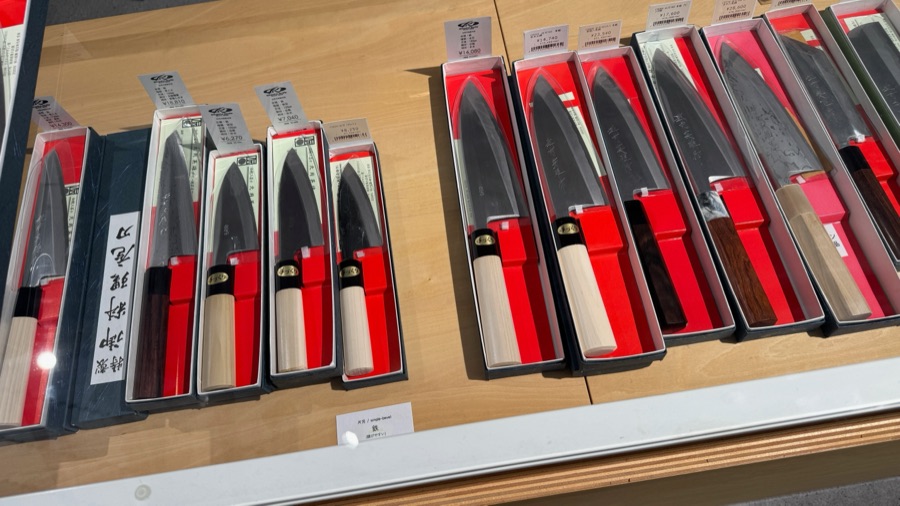
Our photo from the Takefu Knife Village shop, not the item sold online
Hocho Knife
The shop carries knives by Echizen makers including Yu Kurosaki, Takeshi Saji and Yoshimi Kato.
See the knife brands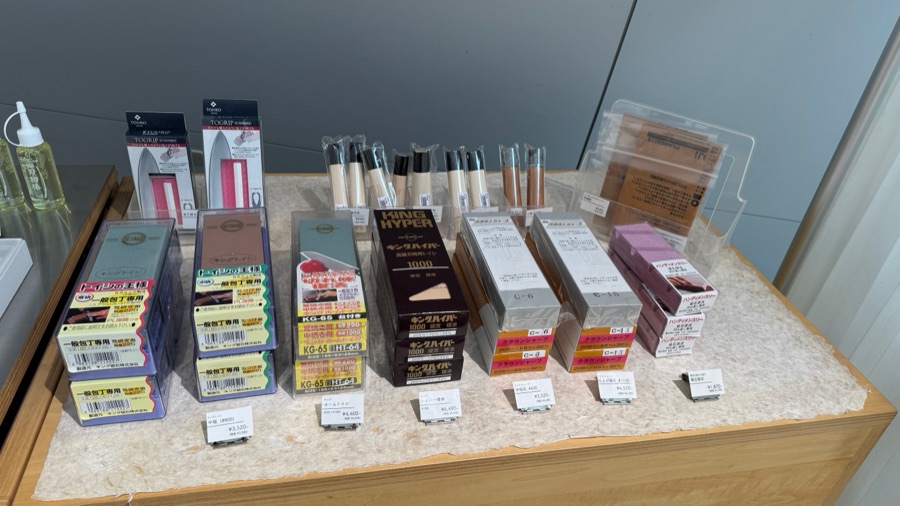
Our photo from the Takefu Knife Village shop, not the item sold online
Where to stay
- Around Takefu: several hotels are near Takefu Station on the Hapi-Line Fukui, within walking distance of most of the restaurants above.
- Tsuruga: the next Shinkansen stop to the south, and the station where you change between the Shinkansen and limited express trains from Kyoto and Osaka. The Hapi-Line Fukui also runs from Tsuruga to Takefu Station.
- Fukui City: the next Shinkansen stop to the north, and the prefectural capital. The Hapi-Line Fukui connects it to Takefu Station too.
- Kyoto: from Kyoto Station, take the Thunderbird limited express to Tsuruga. There, change to the Hokuriku Shinkansen for Echizen-Takefu (the next stop), or to the Hapi-Line Fukui for Takefu Station. On the way back, do the same in reverse. Check train times on a route planner or JR West’s website before you go.