Echizen Knife Types: A Visual Guide to the Knives and Blades Made in Echizen
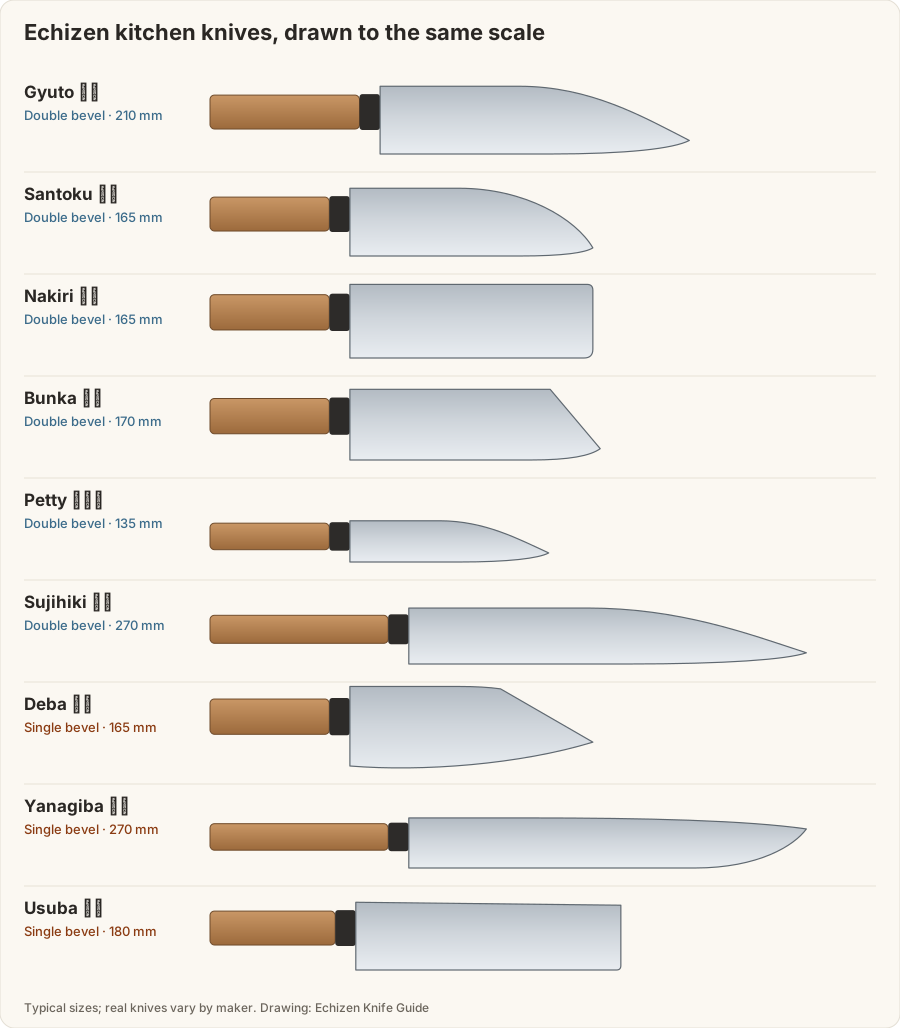
Short answer: Echizen, in Fukui Prefecture, makes far more than one kind of knife. In the kitchen, the everyday shapes are the gyuto (chef’s knife), santoku, nakiri, bunka and petty, all sharpened on both sides, plus the traditional single-bevel deba, yanagiba and usuba for fish and fine vegetable work. Outside the kitchen, Echizen blacksmiths have long made sickles, hatchets (nata) and hedge shears; sickles were what first made the region famous. This guide shows each shape side by side, explains what it is for, and shows what we saw on the shelves and walls of Takefu Knife Village.
We visited Takefu Knife Village on a Sunday in November 2026. The photos on this page are ours, taken in the village shop and museum. We have not cooked with these knives, so this is a guide to shapes and uses, not a review.
Echizen makes more than kitchen knives
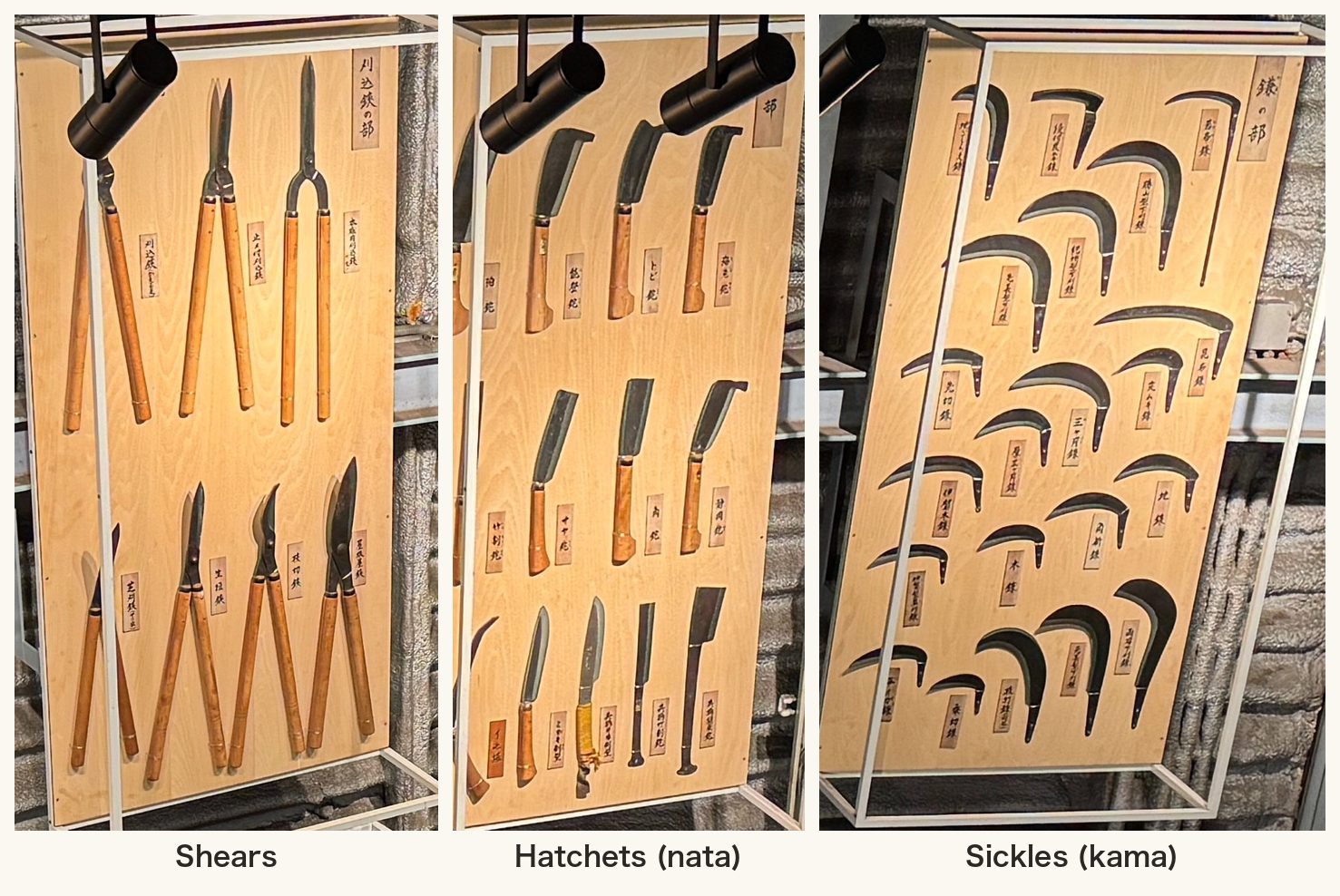
According to the village’s brochure, the main products of Echizen uchihamono (Echizen forged blades) are kitchen knives, sickles, hatchets, hedge shears and hoes. The museum at Takefu Knife Village shows how wide that range is: one wall holds wooden boards, each filled with a different family of blades.
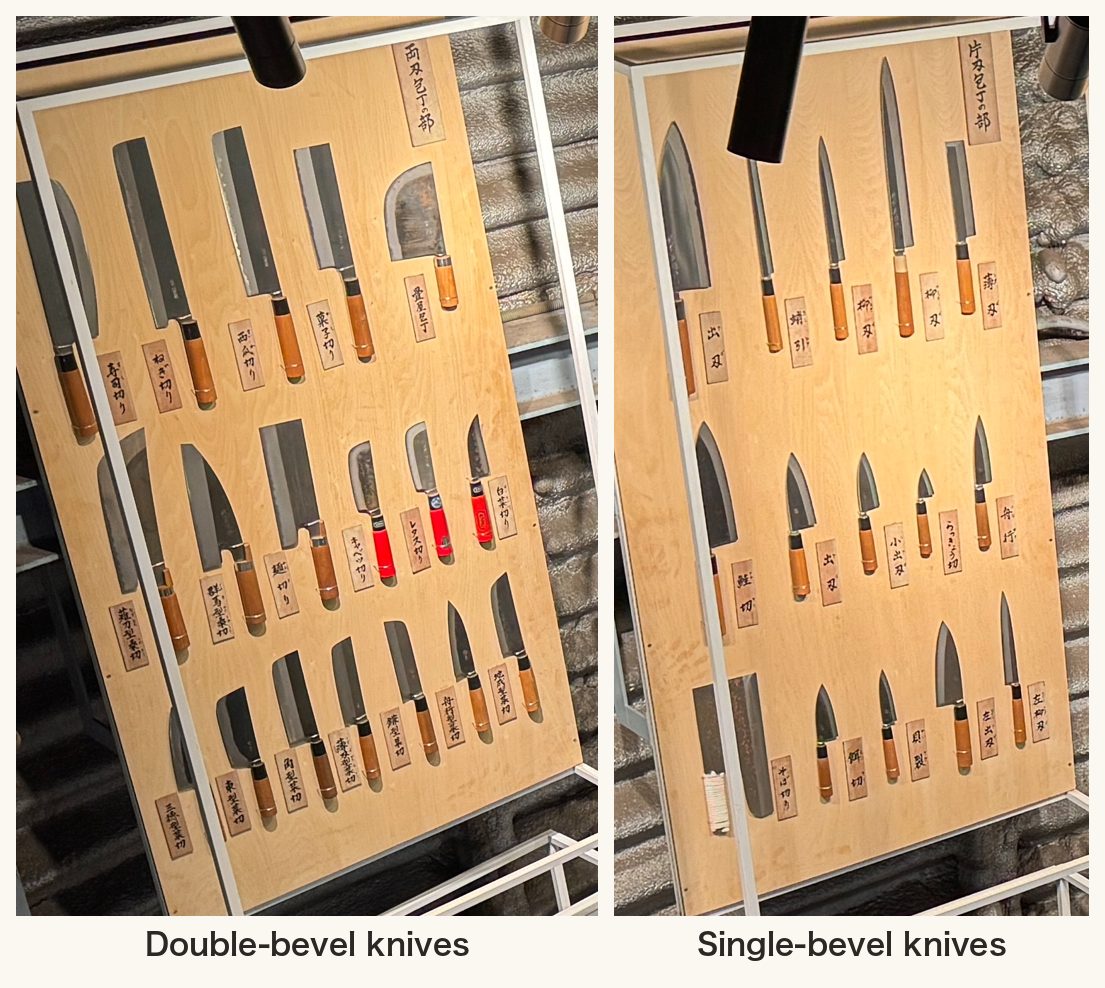
The double-bevel board is a lesson in how specialized Japanese kitchens once were. Its labels include knives for sushi, leeks, watermelon, sweets, noodles, cabbage, lettuce and Chinese cabbage, a tatami maker’s knife, and several regional shapes of nakiri. The single-bevel board has deba, yanagiba, takohiki and usuba, along with knives for salmon, rakkyo (pickled shallots), soba noodles and opening shellfish, and left-handed deba and yanagiba. Single-bevel knives are sharpened on one side only, so left-handed cooks need a mirror-image blade.
Two ways to sharpen a blade
The first thing to know about any Japanese knife is whether it is double-bevel or single-bevel.
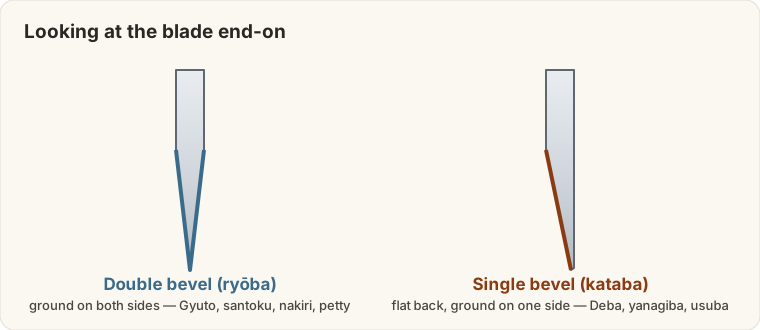
- Double bevel (ryōba): ground on both sides, like most Western knives. Easier to cut straight, easier to sharpen, and the same knife works for right- and left-handed cooks. Gyuto, santoku, nakiri, bunka, petty and sujihiki are double-bevel.
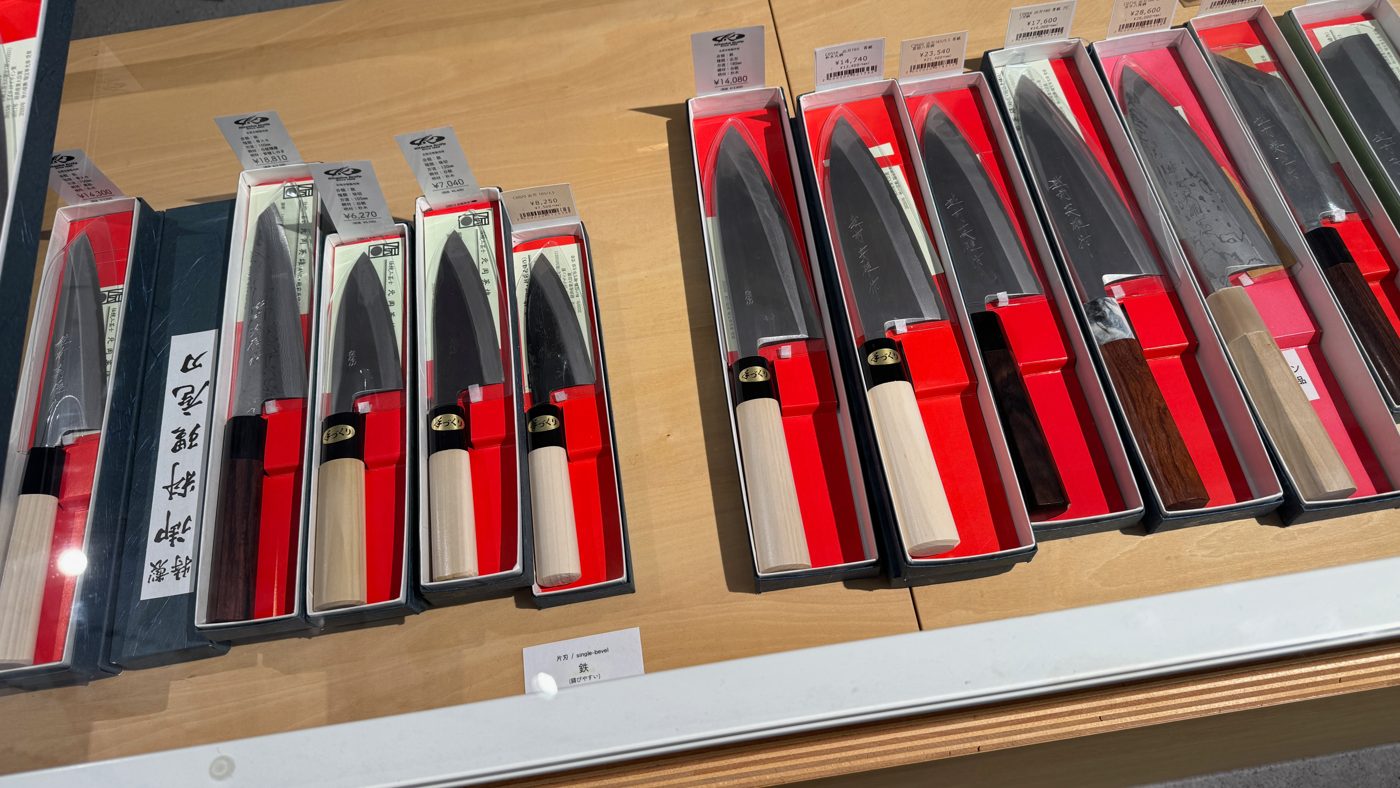
- Single bevel (kataba): one side is ground and the other is nearly flat. This gives a very keen edge for clean slices of fish and paper-thin vegetables, but it takes practice to sharpen, and right- and left-handed versions are different knives. Deba, yanagiba and usuba are single-bevel.
How the blades are built
Many Echizen blades are not one piece of steel. A thin layer of hard steel (hagane) forms the edge, and softer iron or stainless steel (jigane) around it makes the blade tougher and easier to sharpen.
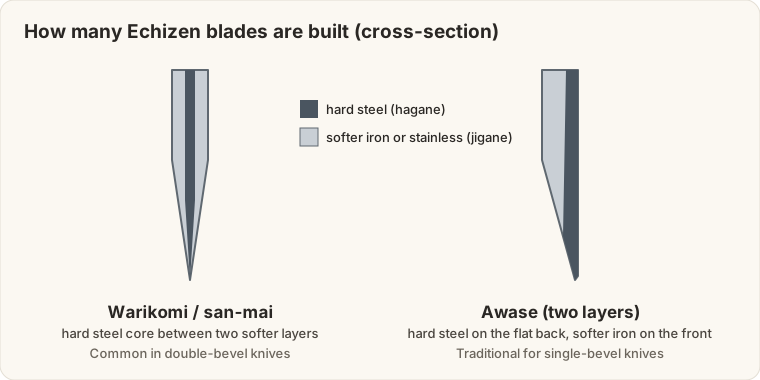
How that steel is forged, from forge-welding to the Echizen technique of hammering two blades at once, is covered step by step in How an Echizen Knife Is Made.
The kitchen knives, one by one

Gyuto 牛刀 Double bevel
Best for: almost everything: meat, fish, vegetables. The Japanese chef’s knife.
Common lengths: 180–270 mm; 210 mm is a popular all-round size.
Good to know: the name means “beef sword”. It is longer and has a more pointed tip than a santoku.
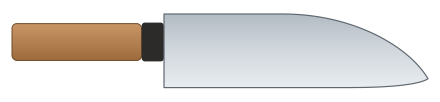
Santoku 三徳 Double bevel
Best for: home cooking: vegetables, meat and fish. The usual “one knife” in a Japanese home.
Common lengths: about 165–180 mm.
Good to know: the spine curves down to a tip near the edge, which makes it less pointed and easy to control.

Nakiri 菜切 Double bevel
Best for: vegetables. The straight edge meets the board along its whole length, so it chops cleanly without rocking.
Common lengths: about 165 mm.
Good to know: the museum board shows several regional nakiri shapes, a reminder that each area had its own idea of a vegetable knife.
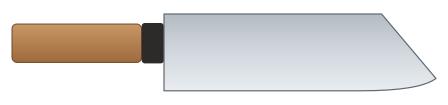
Bunka 文化 Double bevel
Best for: the same jobs as a santoku, with a sharper, angled tip for fine work.
Common lengths: about 165–180 mm.
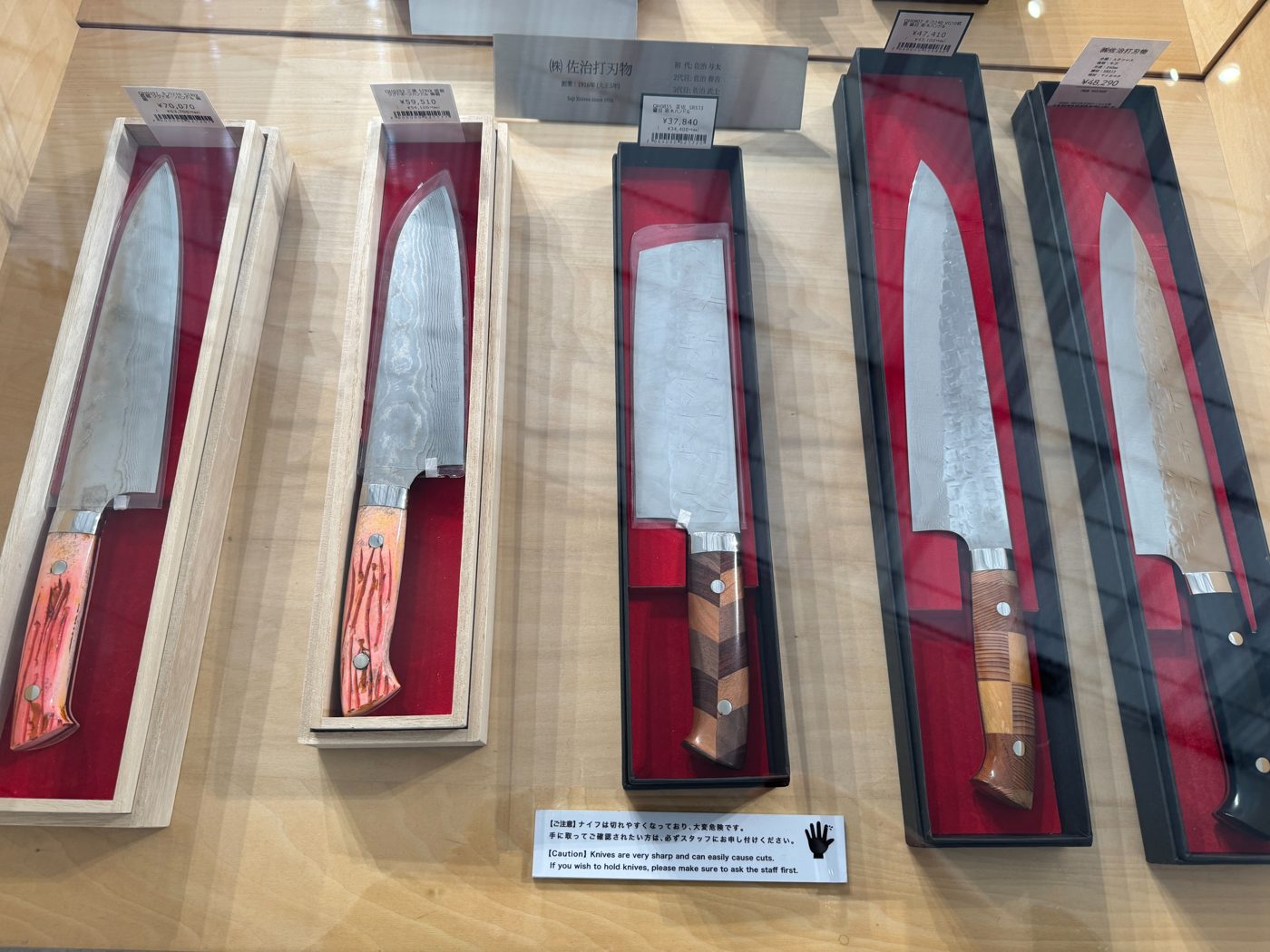
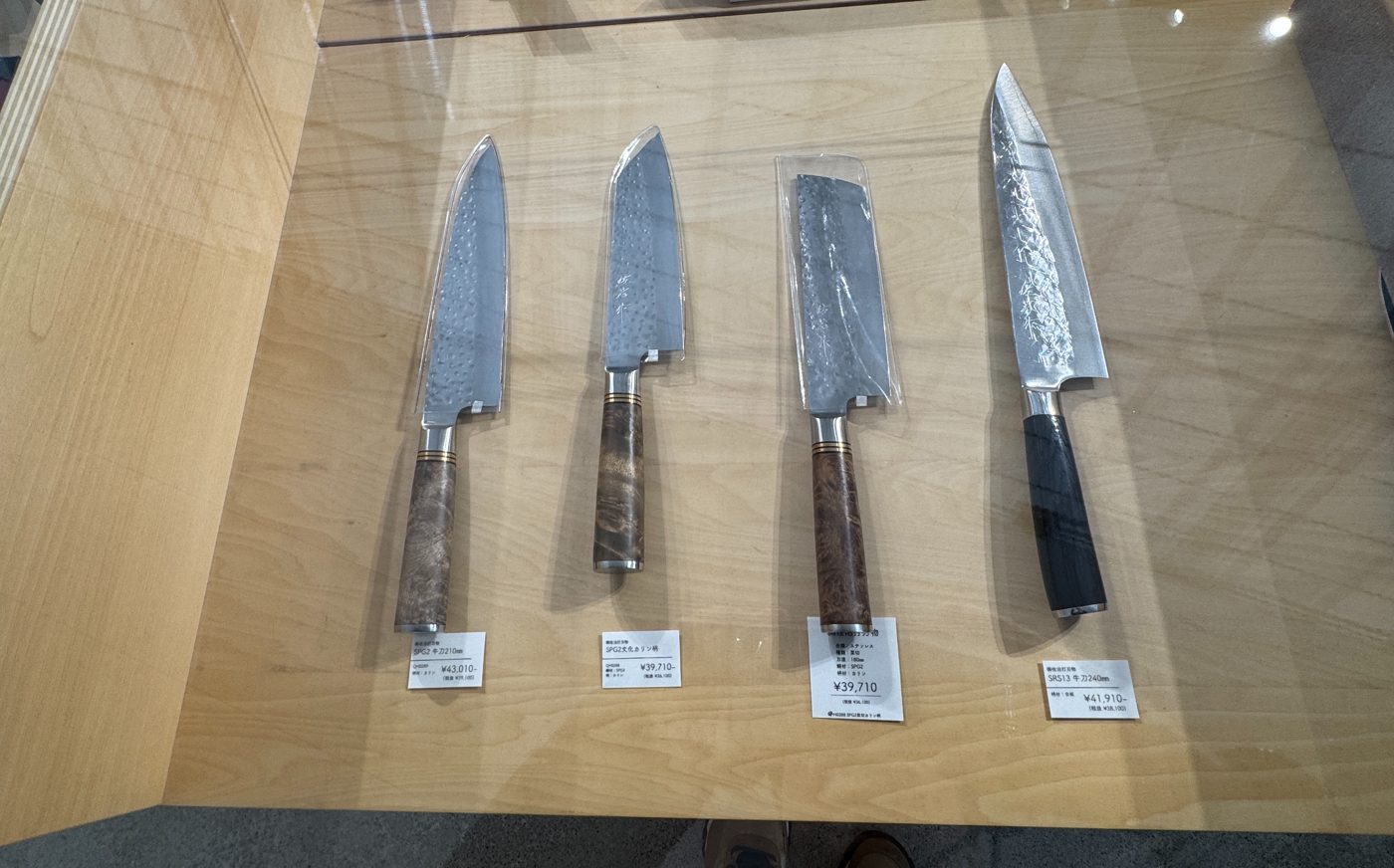
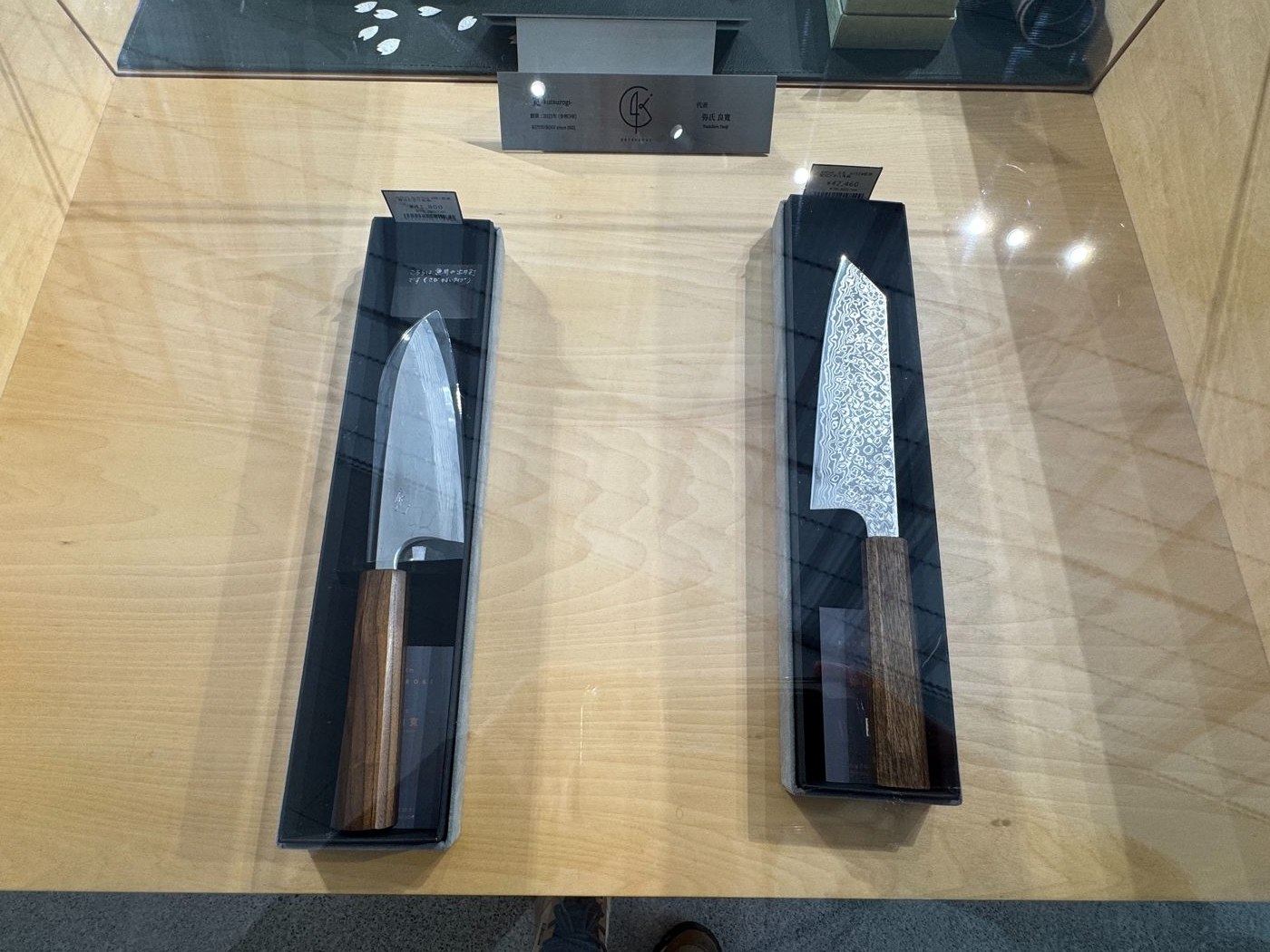
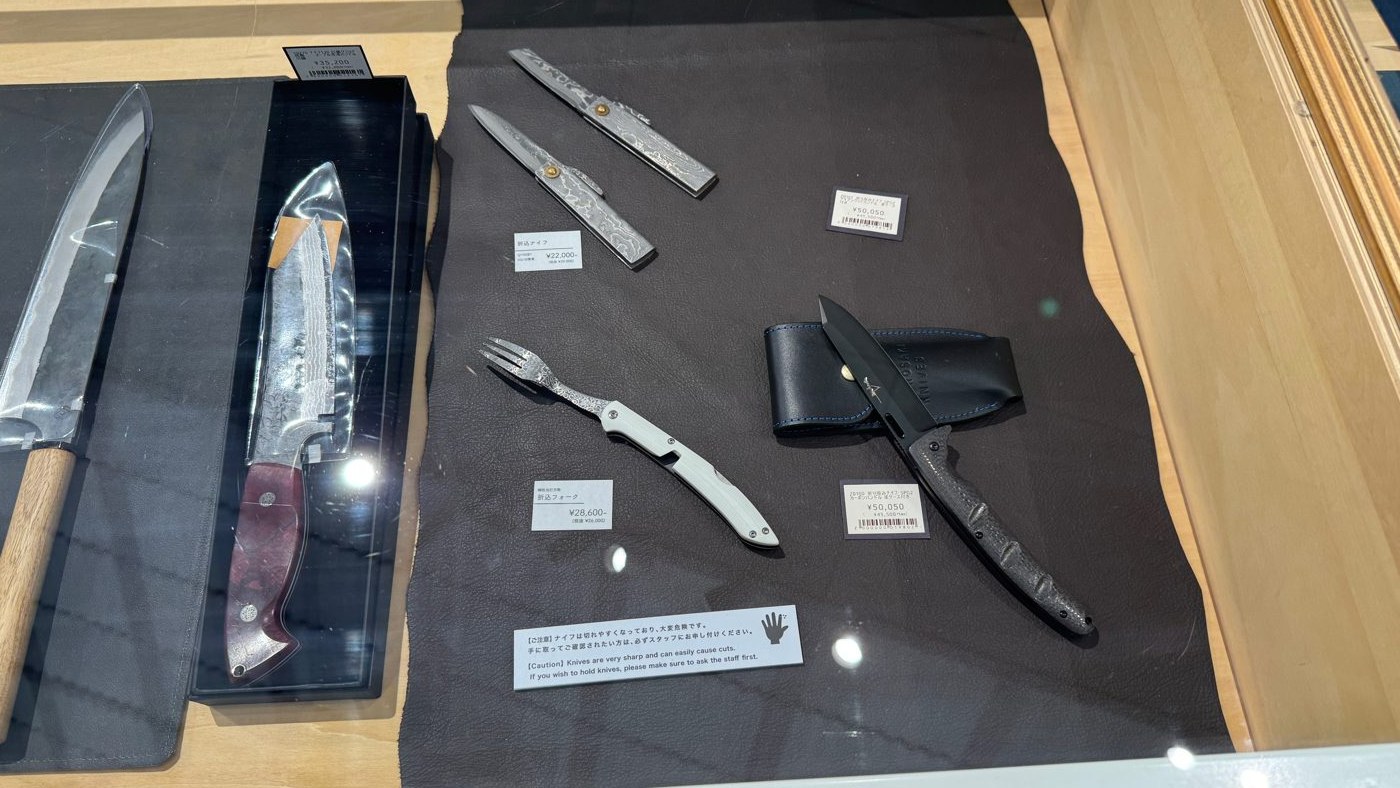
Good to know: the angled “k-tip” makes it easy to recognize. We saw one with a Damascus pattern in the village shop.

Petty ペティ Double bevel
Best for: small jobs: fruit, garnishes, trimming, anything a big knife is clumsy for.
Common lengths: about 120–150 mm.
Good to know: the name comes from the French petit. A petty plus a gyuto or santoku covers most kitchens.

Sujihiki 筋引 Double bevel
Best for: slicing cooked or raw meat and fish in one long stroke, such as roasts or ham.
Common lengths: about 240–300 mm.
Good to know: narrower than a gyuto, so less steel drags through the food.
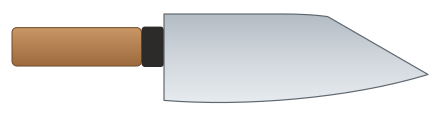
Deba 出刃 Single bevel
Best for: breaking down whole fish: heads, bones and fillets.
Common lengths: about 105–210 mm; small versions (ko-deba) exist for small fish.
Good to know: thick and heavy at the spine. It is not a meat cleaver; it is made for fish bones.

Yanagiba 柳刃 Single bevel
Best for: sashimi. One long pulling stroke gives a clean, glossy cut.
Common lengths: about 240–300 mm.
Good to know: the name means “willow blade”. The takohiki, with a squared-off tip, is a regional cousin.

Usuba 薄刃 Single bevel
Best for: fine vegetable work in Japanese cuisine, such as peeling a radish into one long thin sheet.
Common lengths: about 165–210 mm.
Good to know: it looks like a nakiri, but it is single-bevel and sharpened like a professional’s tool.
What we saw in the village shop
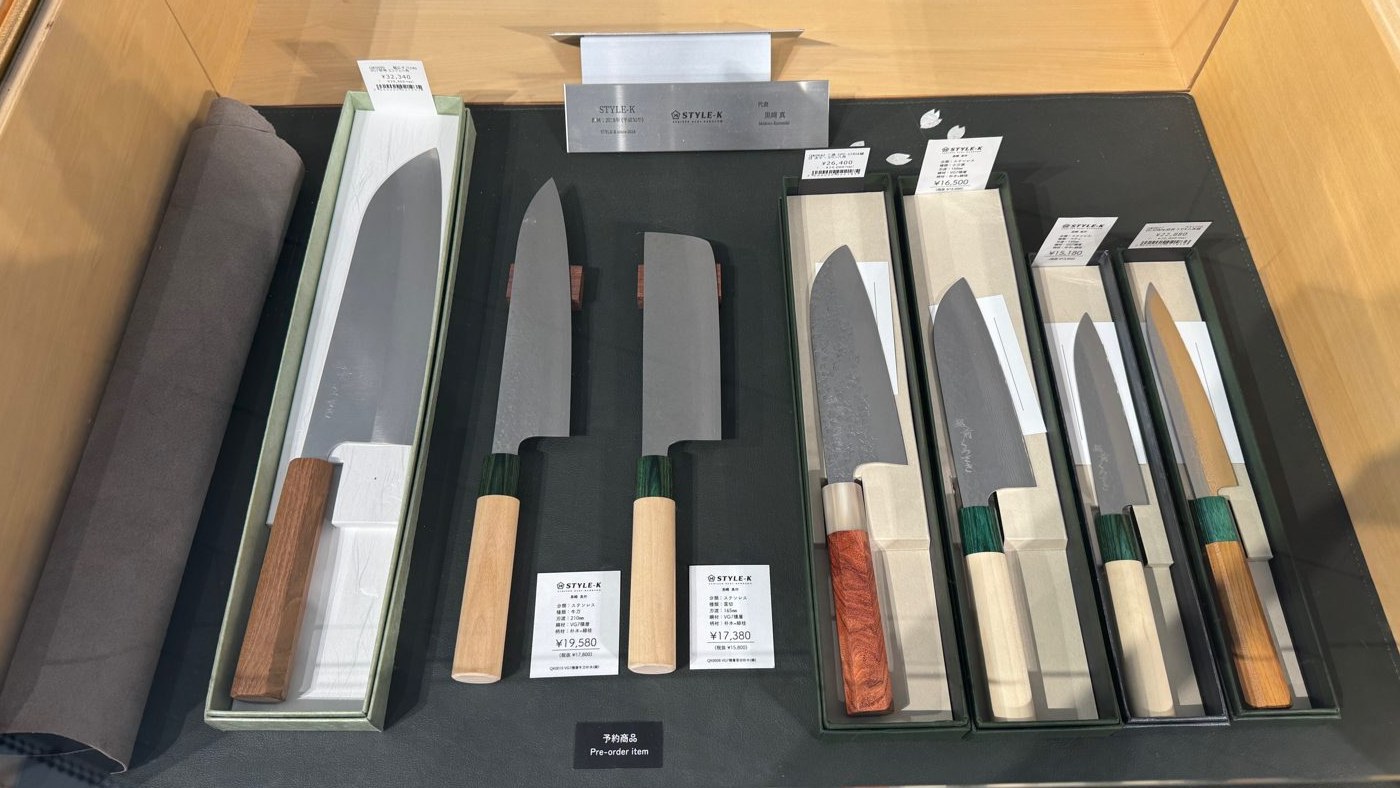
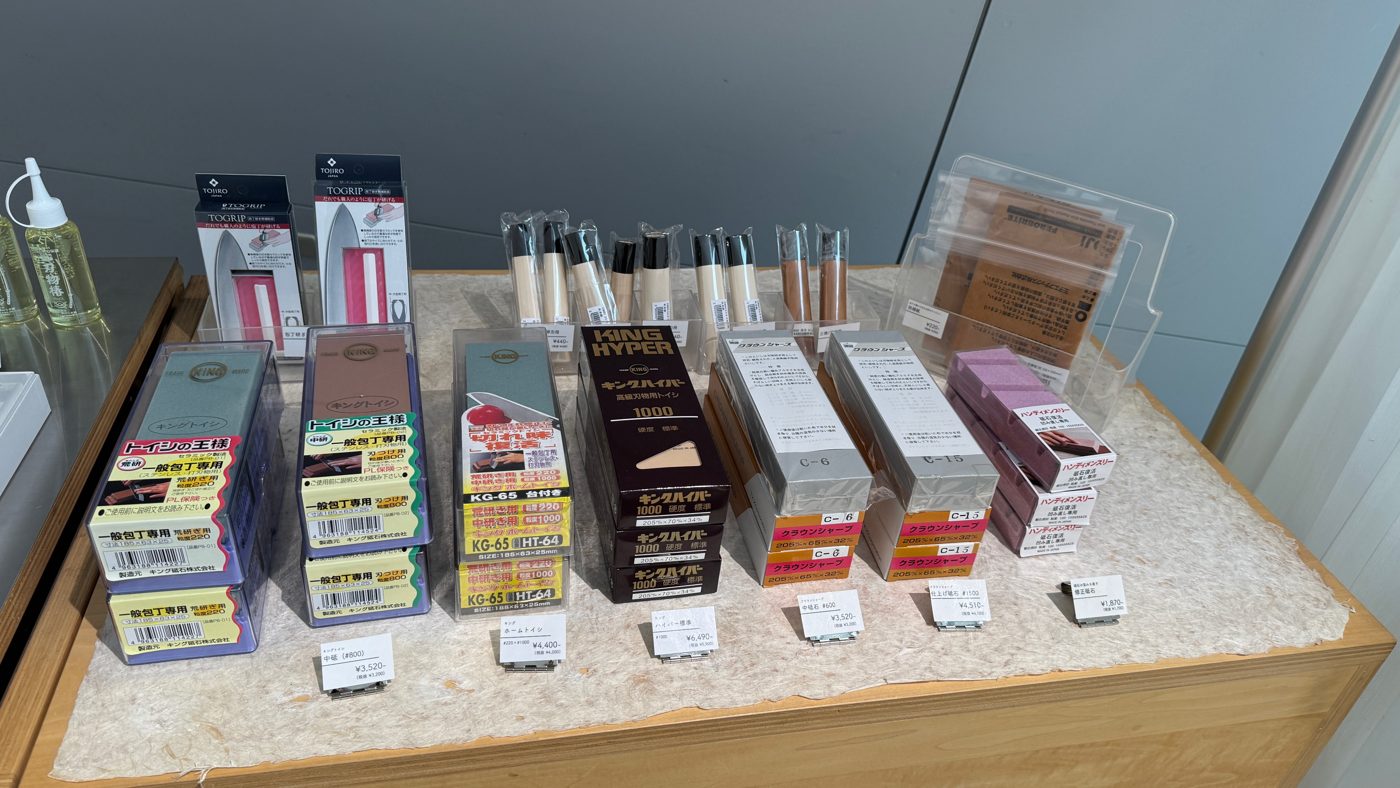
The shop at Takefu Knife Village sells knives from the village’s member workshops side by side, so it is a good place to see these shapes for real.
Finishes and steels
Two knives of the same shape can look completely different. These are the finishes you will see most often:
- Kurouchi (black finish): the dark scale from forging is left on the upper blade. Rustic, and it shows the blacksmith’s work.
- Tsuchime (hammered): small hammer dents on the blade face. Attractive, and often said to help food release.
- Damascus: layers of different steels folded or stacked and etched to show a wavy pattern. The pattern is in the outer layers; the cutting edge is the steel core.
- Migaki (polished): a clean, bright surface.
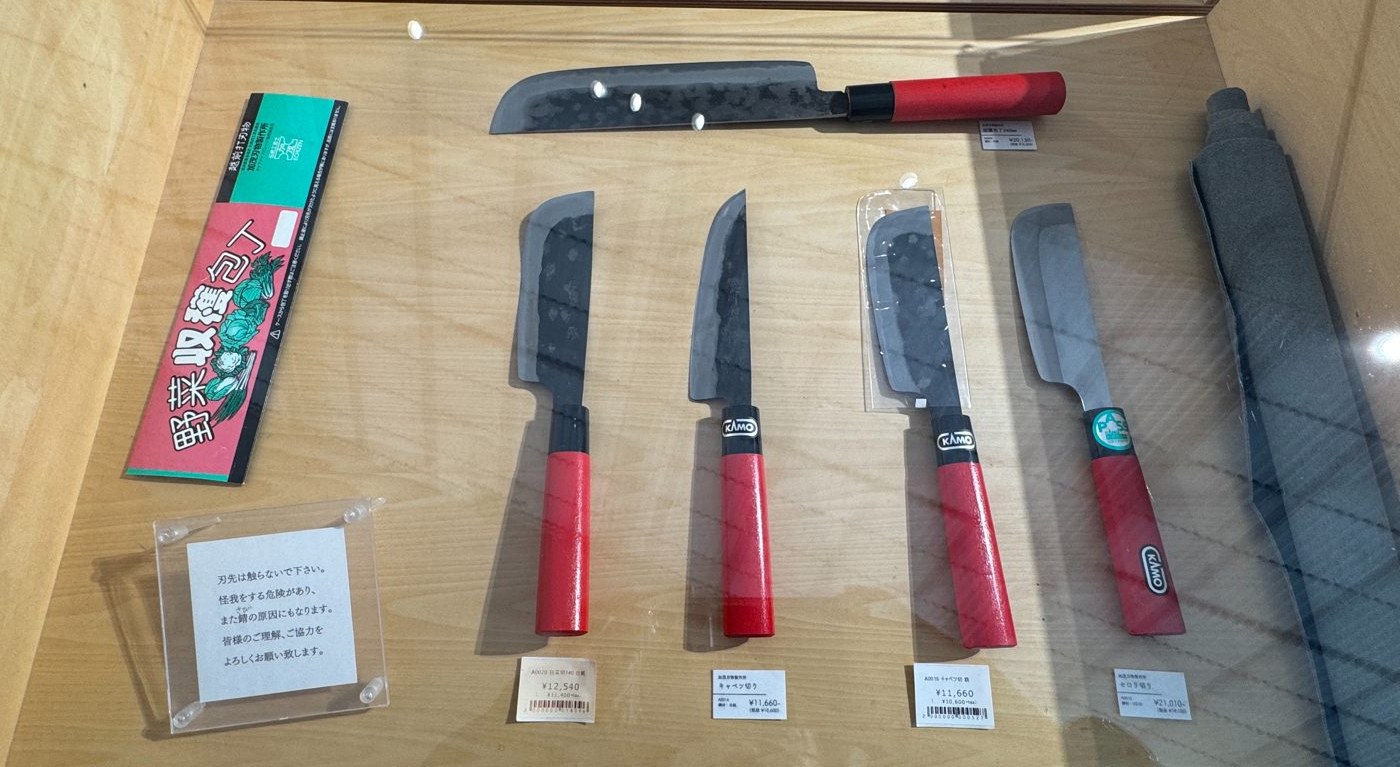
The steel matters more than the finish. Carbon steels such as Shirogami (White paper) and Aogami (Blue paper) take a very keen edge but rust if left wet. Stainless steels are much easier to live with. Two well-known stainless steels come from Echizen itself: Takefu Special Steel, a steel maker in Echizen City, lists V-Kin No. 10 (VG10) and Super Gold 2 (SG2) among its blade steels. Whatever the steel, wash and dry the knife by hand, and keep it out of the dishwasher.
Beyond the kitchen: sickles, hatchets and shears
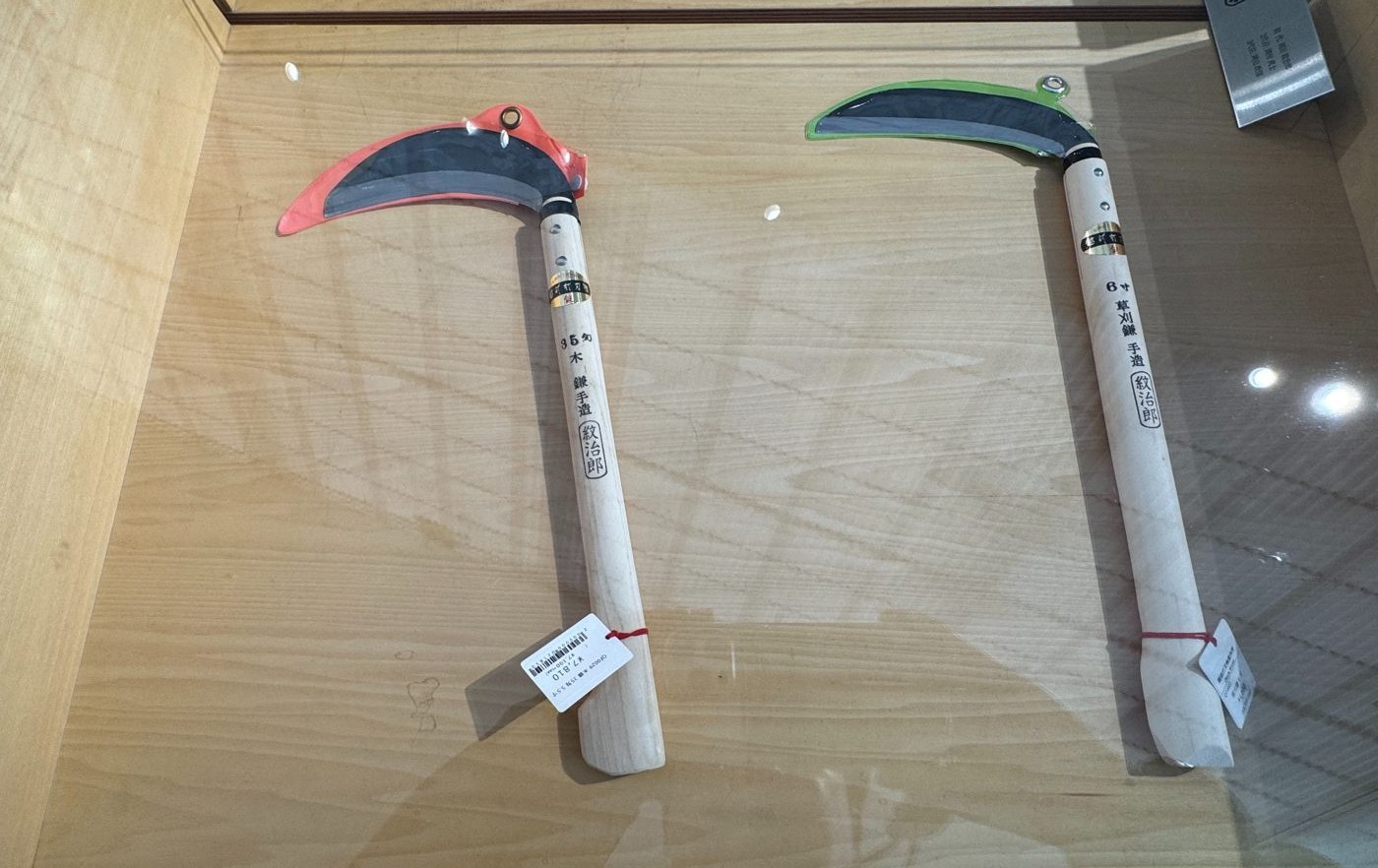
Echizen’s blacksmiths made their name with farm tools. According to the village brochure, traveling lacquer gatherers carried Echizen sickles around Japan and brought back orders for regional shapes; our museum article has the history and the figures.
Kama (sickle) 鎌 Farm tool
Used for: cutting grass, rice and weeds by hand.
Good to know: the shape changes with the job and the region, as the museum board shows. The sickle has its own 15-step process board in the museum, and Echizen sickles traditionally use a technique called mawashi-hagane-tsuke.
Nata (hatchet) 鉈 Forest tool
Used for: splitting kindling, clearing branches and brush.
Good to know: heavier and thicker than any kitchen knife. The museum board shows square-ended, hooked and pointed nata.
Karikomi-basami (hedge shears) 刈込鋏 Garden tool
Used for: trimming hedges and shaping garden shrubs.
Good to know: the museum board also shows pruning shears for branches and shears for cutting grass.
New designs from an old craft
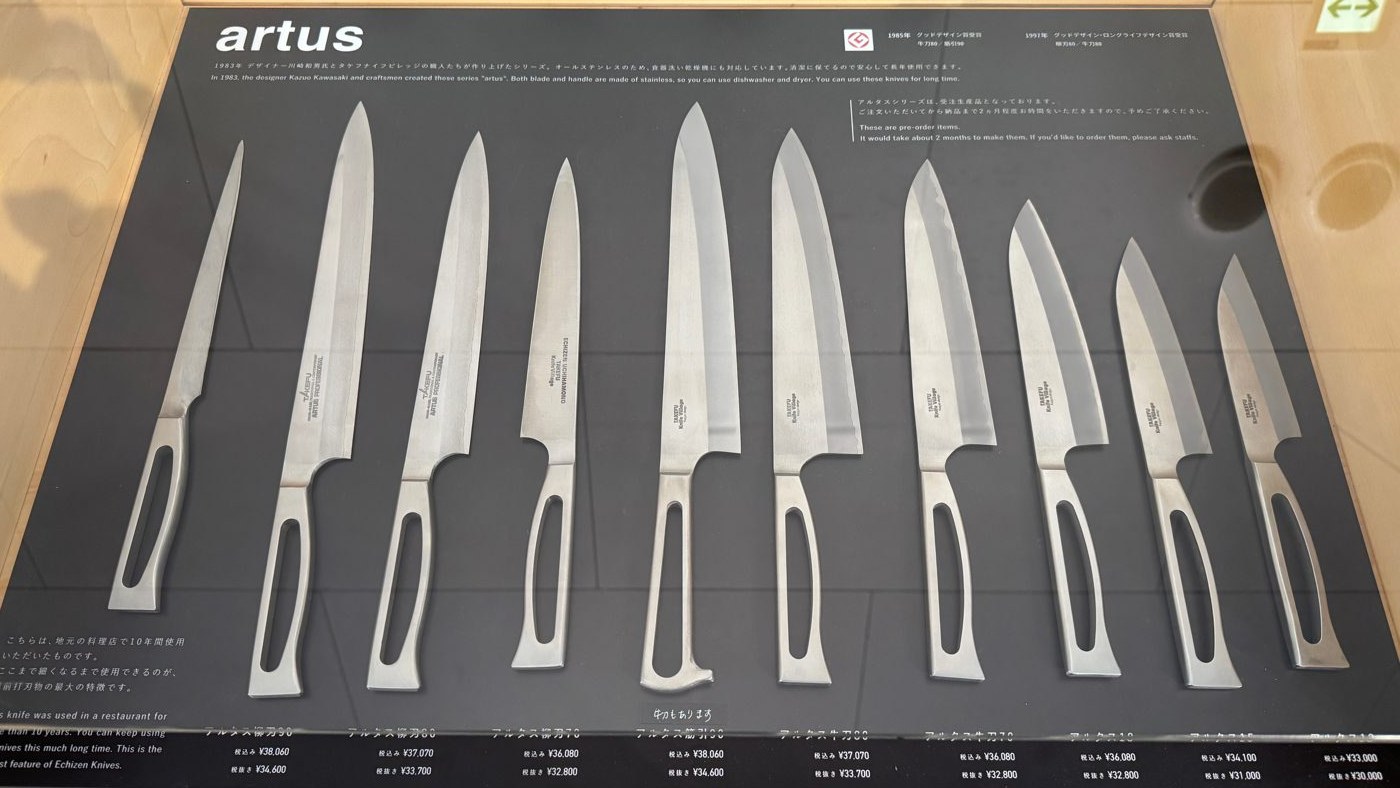
Echizen’s makers have also worked with designers. In 1982 the group of craftsmen who later built the village began working with the Fukui-born industrial designer Kazuo Kawasaki, and today the shop shows modern one-piece stainless designs alongside folding and outdoor knives.
Which one should you choose?
| If you want… | Look at |
|---|---|
| One knife for everything | Gyuto (210 mm) or santoku |
| Mostly vegetables | Nakiri |
| A second, small knife | Petty |
| To fillet whole fish | Deba |
| To slice sashimi | Yanagiba |
| Low maintenance | Stainless steel (for example VG10 or SG2) |
| The sharpest edge, and you don’t mind care | Carbon steel (Shirogami or Aogami) |
If you are new to Japanese knives, start with a double-bevel gyuto or santoku in stainless steel. Single-bevel knives are best once you know you will use them for fish or Japanese-style vegetable cutting.
See them in person
The best place to compare these shapes is the shop at Takefu Knife Village, where many Echizen makers’ knives sit side by side. For opening hours, the viewing workshop and how to get there from Echizen-Takefu Station, see our Takefu Knife Village guide.
Where to stay
- Around Takefu: several hotels are near Takefu Station on the Hapi-Line Fukui.
- Tsuruga: the next Shinkansen stop to the south, and the station where you change between the Shinkansen and limited express trains from Kyoto and Osaka.
- Fukui City: the next Shinkansen stop to the north, and the prefectural capital.
- Kyoto: from Kyoto Station, take the Thunderbird limited express to Tsuruga and change there to the Hokuriku Shinkansen; Echizen-Takefu is the next stop (on the way back, do the same in reverse). It is a longer trip, but it works if Kyoto is your base. Check train times on a route planner or JR West’s website before you go.
Buying an Echizen knife online
If you can’t make the trip, you can order knives by Echizen makers online. Hocho Knife carries several Echizen smiths, including Takeshi Saji, Yu Kurosaki, Yoshimi Kato and Takayuki Iwai.
Echizen knives online (Hocho Knife)
Hocho Knife is a Japanese knife shop that ships internationally. We have not used these products ourselves, so we don't rate them. The pictures are our own drawings and photos, not the items sold. We picked one knife for each type above, all from makers the shop lists as Echizen smiths. Check prices, stock and shipping on the shop's pages.
Our drawing of the type, not the item sold
Hocho Knife
Gyuto · Yu Kurosaki Senko, 210 mm
An all-purpose double-bevel knife in R2 (SG2) powdered stainless steel with a hammered finish.
See it on Hocho KnifeOur drawing of the type, not the item sold
Hocho Knife
Santoku · Yoshimi Kato Kurouchi, 170 mm
An Aogami Super carbon-steel core clad in stainless, with the dark kurouchi finish.
See it on Hocho KnifeOur drawing of the type, not the item sold
Hocho Knife
Nakiri · Yoshimi Kato Black Damascus, 165 mm
A straight-edged vegetable knife in 63-layer VG10 Damascus.
See it on Hocho KnifeOur drawing of the type, not the item sold
Hocho Knife
Bunka · Takeshi Saji Black Damascus, 180 mm
The angled-tip bunka in R2 (SG2) Damascus with a desert ironwood handle.
See it on Hocho KnifeOur drawing of the type, not the item sold
Hocho Knife
Petty · Yu Kurosaki Senko, 120 mm
A small utility knife for peeling and detail work, in hammered R2 (SG2).
See it on Hocho KnifeOur drawing of the type, not the item sold
Hocho Knife
Sujihiki · Takeshi Saji Diamond Finish Damascus, 240 mm
A long slicer for meat and fish, with a blue turquoise handle.
See it on Hocho KnifeOur drawing of the type, not the item sold
Hocho Knife
Deba · Takayuki Iwai Shirogami No.1, 165 mm
A heavy single-bevel knife for breaking down fish. Carbon steel: dry it right after use.
See it on Hocho KnifeOur drawing of the type, not the item sold
Hocho Knife
Yanagiba · Takayuki Iwai Kurouchi, 270 mm
A long single-bevel sashimi knife in Aogami No.2 carbon steel.
See it on Hocho KnifeOur drawing of the type, not the item sold
Hocho Knife
Usuba · Takayuki Iwai Kamagata, 210 mm
A single-bevel vegetable knife. This is the kamagata style, with a pointed tip instead of the square end in our drawing.
See it on Hocho KnifeOur photo from the Takefu Knife Village shop, not the item sold online