How an Echizen Knife Is Made: What the Takefu Knife Village Museum Teaches
Short answer: The small museum at Takefu Knife Village explains, mostly through objects and panels, how Echizen blades are made: two wall boards show a kitchen knife and a sickle at fifteen stages each, a floor map over the shared workshop labels the stations from forging to the final edge, and a panel explains why heat treatment decides whether steel is “alive” or “dead.” This article walks through what those exhibits say. For opening hours, the shop and how to get there, see our Takefu Knife Village guide.
We visited on a Sunday in November 2026. On that Sunday, one craftsman was working at a grinding wheel in the workshop. Everything below comes from the panels and the brochures we picked up.
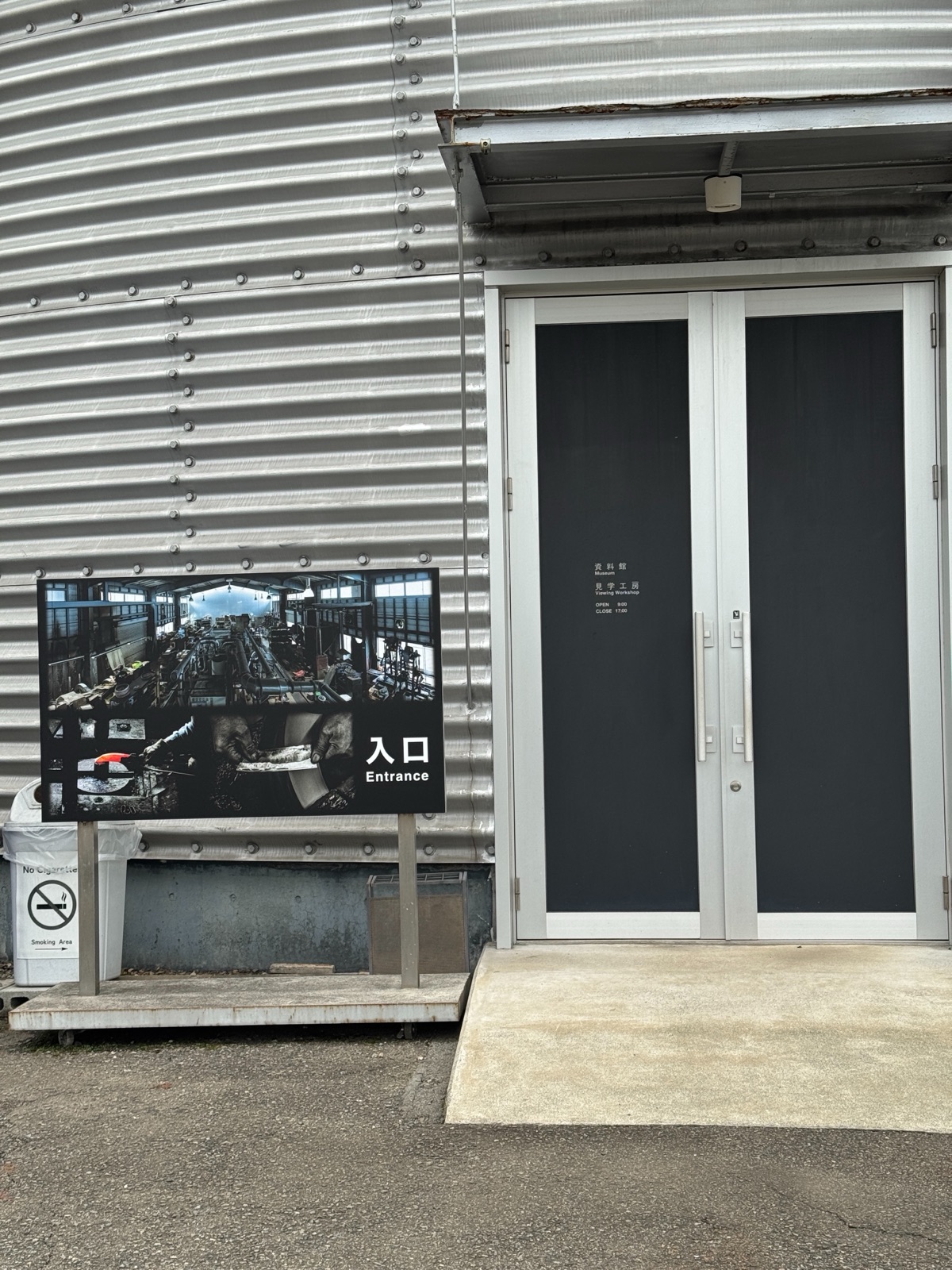
Where the tradition comes from
In 1337, during the Nanboku-chō period, the Kyoto swordsmith Chiyozuru Kuniyasu settled in Fuchū, today’s Echizen City. The sources differ slightly on why: the Knife Village’s brochure and the panel in its museum say he came looking for water good for forging swords, while the brochure of the Echizen Knife Hall of Fame (Echizen Chiyozuru no Yakata, another facility in the city) says he was looking for land suited to making them. Both agree on what happened next: alongside his swords, he made crescent-shaped sickles for local farmers, and that is counted as the beginning of Echizen uchihamono (Echizen forged blades).
The Hall of Fame brochure adds a story. Wanting swords to be symbols of the samurai rather than weapons, Kuniyasu is said to have carved a whetstone into a koma-inu (a shrine guardian dog) each time he made a sword and sunk it in a pond, and whetstone koma-inu have in fact been found there. The Knife Village’s brochure says the co-op carved a koma-inu into its own logo to keep that wish alive.
Sickles, not kitchen knives, made the region’s name. According to the village brochure, lacquer gatherers who supplied Echizen lacquerware and traveled the country tapping lacquer trees used Takefu sickles, sold blades to pay for their journeys and brought home orders for sickles suited to each region. By one account, in 1874 Echizen made about 970,000 of the roughly 3.53 million sickles produced in Japan, about 27.5%. In 1979, Echizen uchihamono became the first forged-blade product in Japan to be designated a national Traditional Craft.
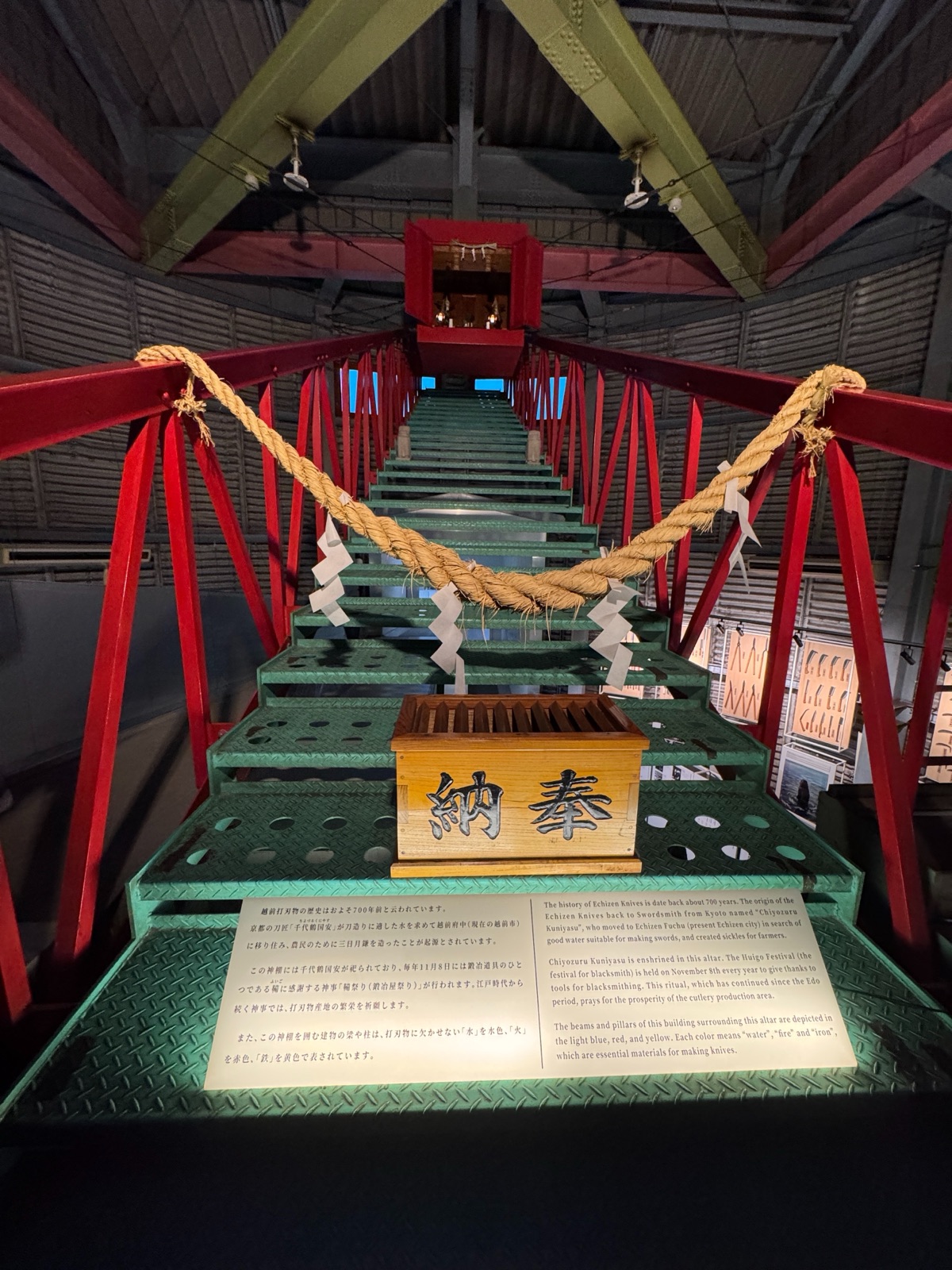
In the same building there is a small altar hung with a shimenawa straw rope. Its panel says Chiyozuru Kuniyasu is enshrined there, and that every year on November 8 a festival held since the Edo period gives thanks to the fuigo (the blacksmith’s bellows) and prays for the prosperity of the production area. The beams and pillars around it are painted light blue, red and yellow for water, fire and iron, the three things a knife cannot be made without.
Fifteen steps on one wall
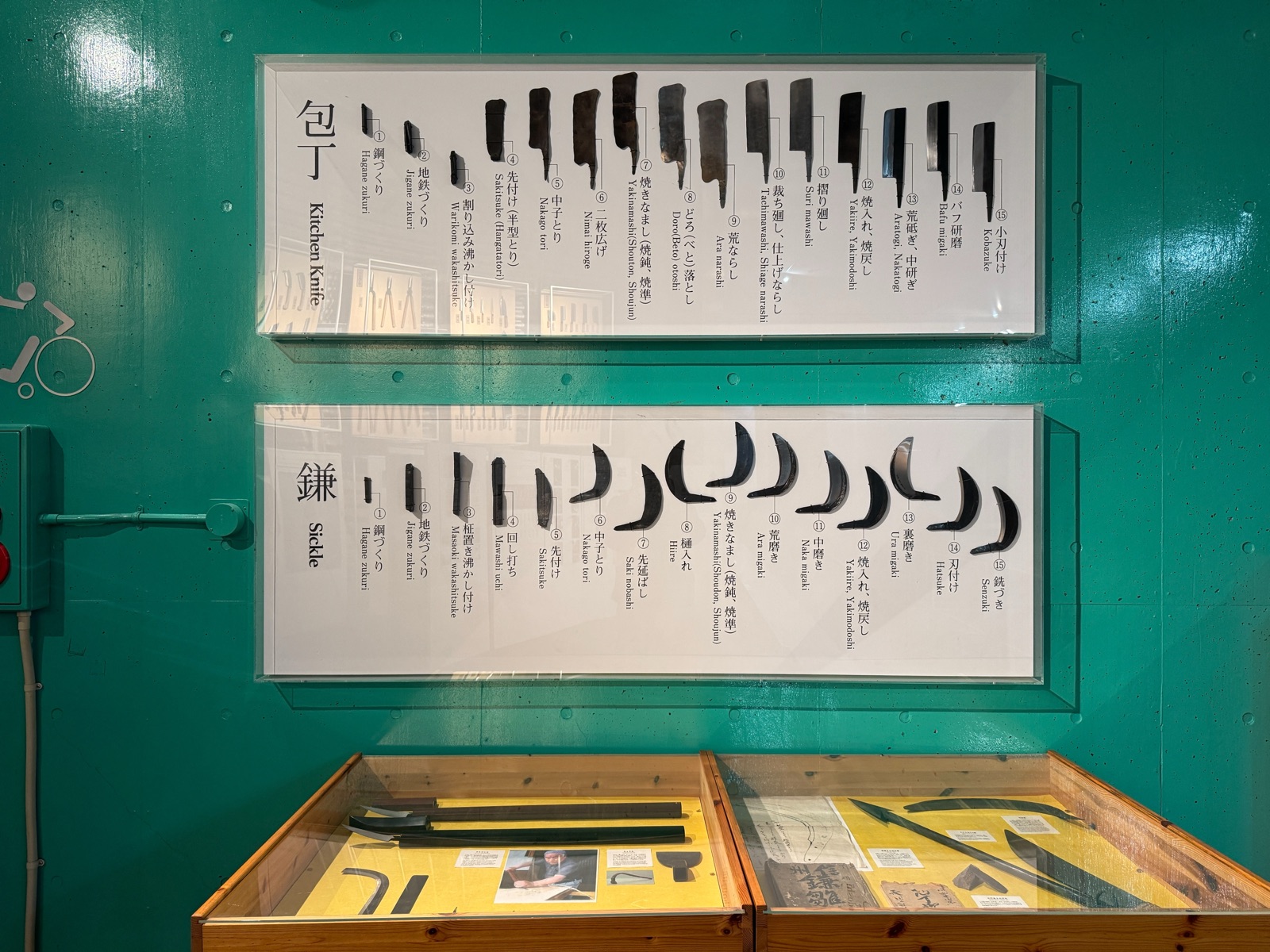
On a green wall hang two boards. Each holds actual pieces of metal, one for every stage, labeled in Japanese and romanized Japanese.
The kitchen knife board starts with making the steel (hagane-zukuri) and the base iron (jigane-zukuri), then forge-welds the steel into a split in the iron (warikomi wakashitsuke). Next come sakitsuke, drawing out the tang (nakago-tori) and nimai-hiroge (more on that below), then annealing (yakinamashi), doro-otoshi, leveling and trimming, suri-mawashi (摺り廻し), quenching and tempering, rough and medium sharpening, buffing, and finally the small edge bevel (kobazuke) at step 15.
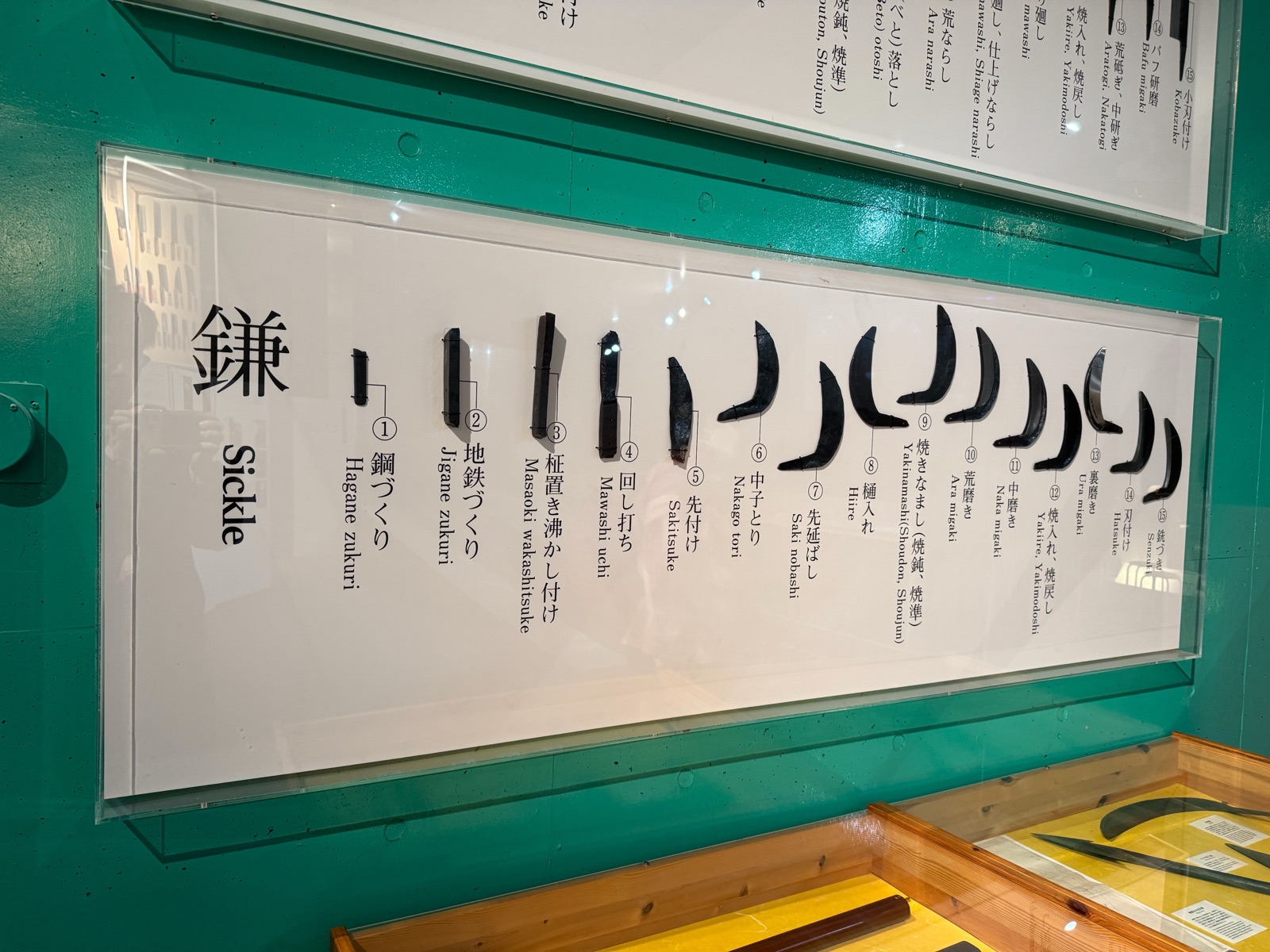
The sickle board follows a different path: after making the steel and iron, step 3 is masaoki wakashitsuke and step 4 is mawashi-uchi, then the tip is drawn out, a groove is added (hiire), and the blade is annealed, polished, hardened, polished on the back and edged, with a last step called senzuki at number 15. Seeing the two boards side by side makes it obvious that a sickle is not just a bent knife.
Two techniques the brochures call distinctive
The Echizen Knife Hall of Fame brochure singles out two methods.
- Nimai-hiroge (for kitchen knives): two blades are stacked and struck from both sides with a belt hammer (in the past, two people with large hammers and one with a small hammer), working quickly so both stretch equally thin. Because the stack is twice as thick, it holds heat better, can be drawn thinner, with less uneven hammering, and it is more efficient for production. The village’s own brochure calls it a forging technique used only in Echizen.
- Mawashi-hagane-tsuke (for sickles and pruning shears): said to have been devised by Kuniyasu himself. The steel is forge-welded onto the narrow side of the base iron (the masaoki method), then flattened from one corner into a diamond shape. This stretches the steel thinner, giving an edge that is easy to sharpen and cuts well, and the brochure says it takes far more skill than the hira-oki method common in other regions.
A process sheet from the same Hall of Fame gives approximate temperatures for a vegetable knife made by the warikomi method: about 800°C for the steel, about 1,000°C for the base iron, about 1,100°C for forge-welding the two, and about 800°C for nimai-hiroge and for quenching.
Reading the workshop floor map
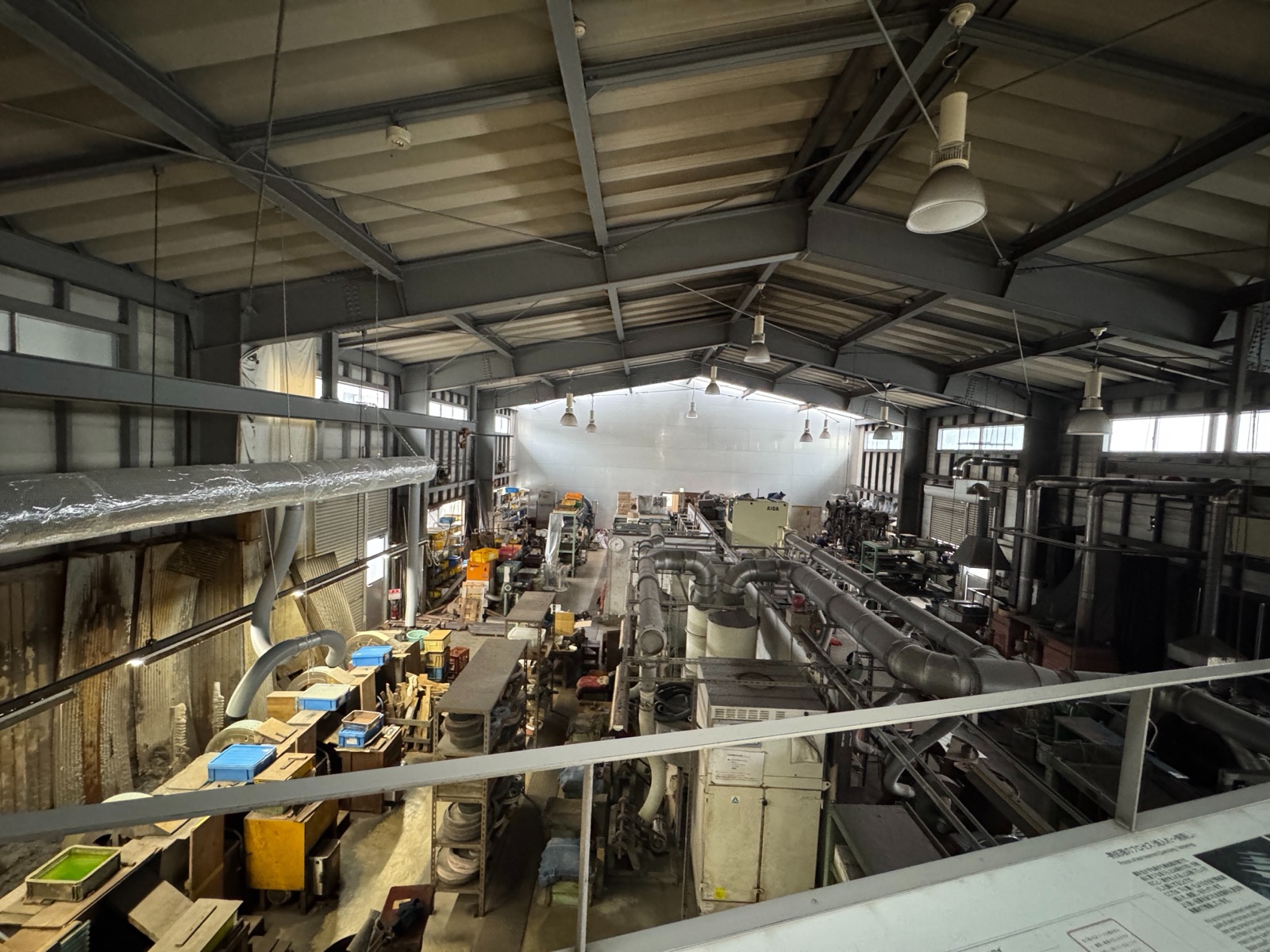
From the viewing walkway you look down on the shared workshop. On the railing, a floor map marks the stations with letters, in Japanese only, so here is what they say:
- A Hizukuri tanzō: fire forging
- B Doro-otoshi machine (shot machine)
- C Ara-narashi: rough leveling
- D Press and cutting (two stations)
- E Shiage-narashi: finish leveling
- F Seikei: shaping
- G Quenching and tempering
- H Straightening (removing distortion)
- I Rough to medium grinding
- J Kobazuke: the small edge bevel (finish sharpening)
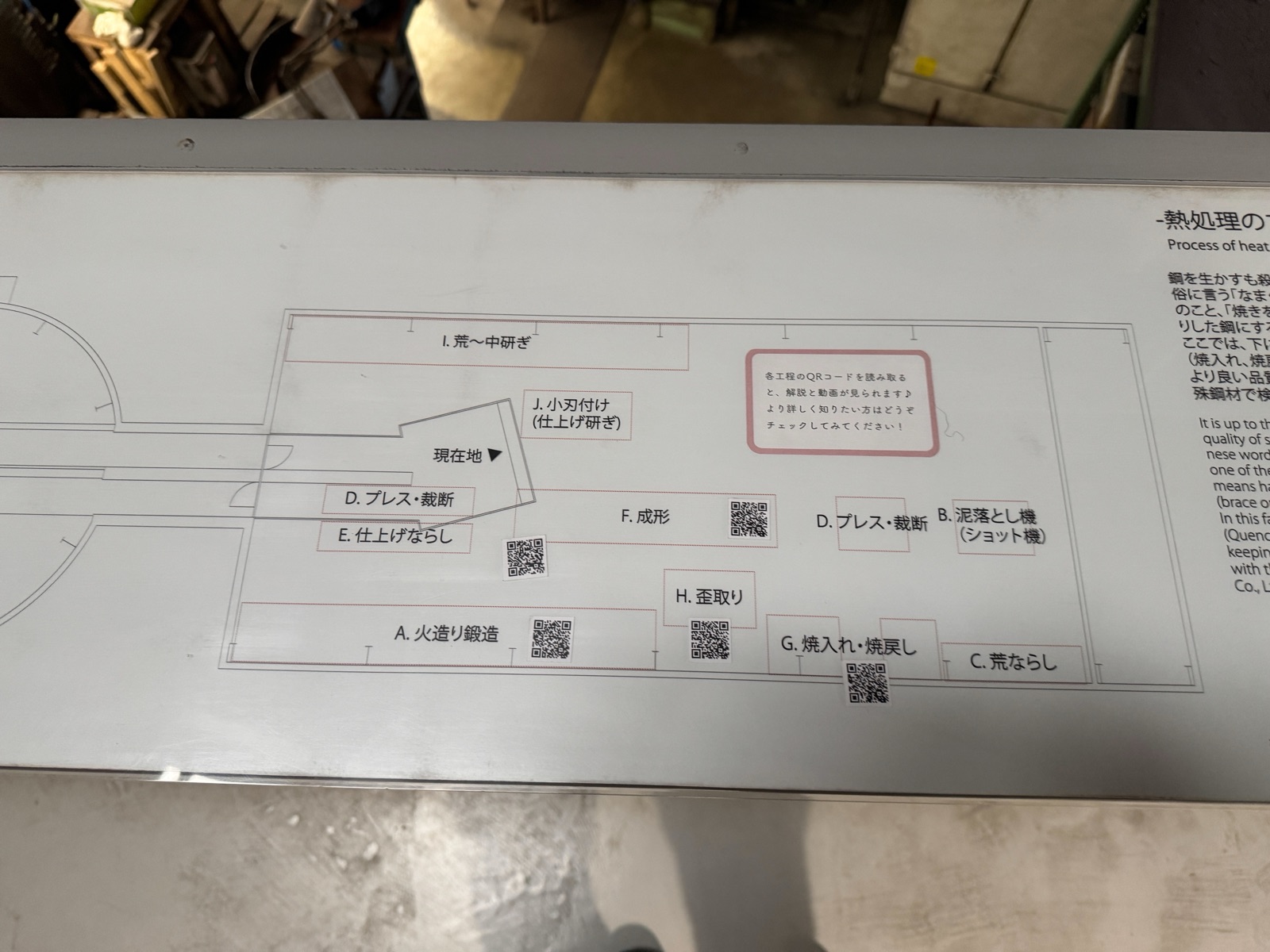
A note on the map says that scanning a station’s QR code shows an explanation and a video.
Why heat treatment decides everything
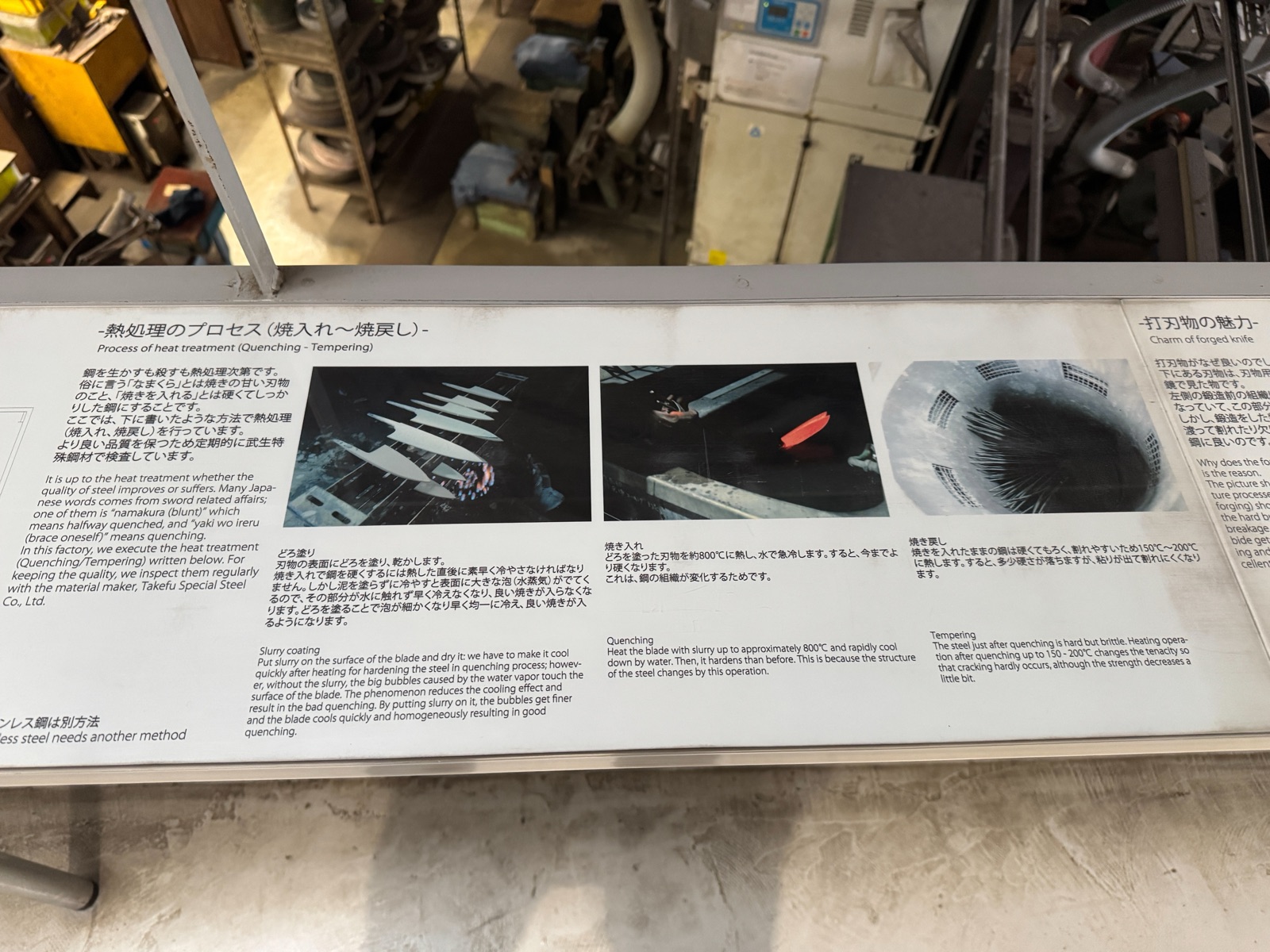
The next panel opens with a line that loosely translates as “Heat treatment makes or breaks the steel.” It notes that namakura, the everyday Japanese word for a blunt, useless blade, refers to one that was poorly hardened. It then explains the three steps used in this workshop:
- Slurry coating (doro-nuri): the blade is coated with a mud slurry (doro) and dried. Without it, big bubbles of steam form on the surface during quenching and keep the water away, so the blade cools unevenly. With it, the bubbles stay fine and the blade cools quickly and evenly.
- Quenching (yakiire): the coated blade is heated to about 800°C and cooled rapidly in water, which changes the steel’s structure and makes it harder.
- Tempering (yakimodoshi): freshly quenched steel is hard but brittle, so it is reheated to 150–200°C. It loses a little hardness but gains toughness and becomes much less likely to crack.
The panel adds that the workshop has its heat treatment inspected regularly with the steel maker Takefu Special Steel, and a note at the edge says stainless steel needs a different method.
The first strike of the year
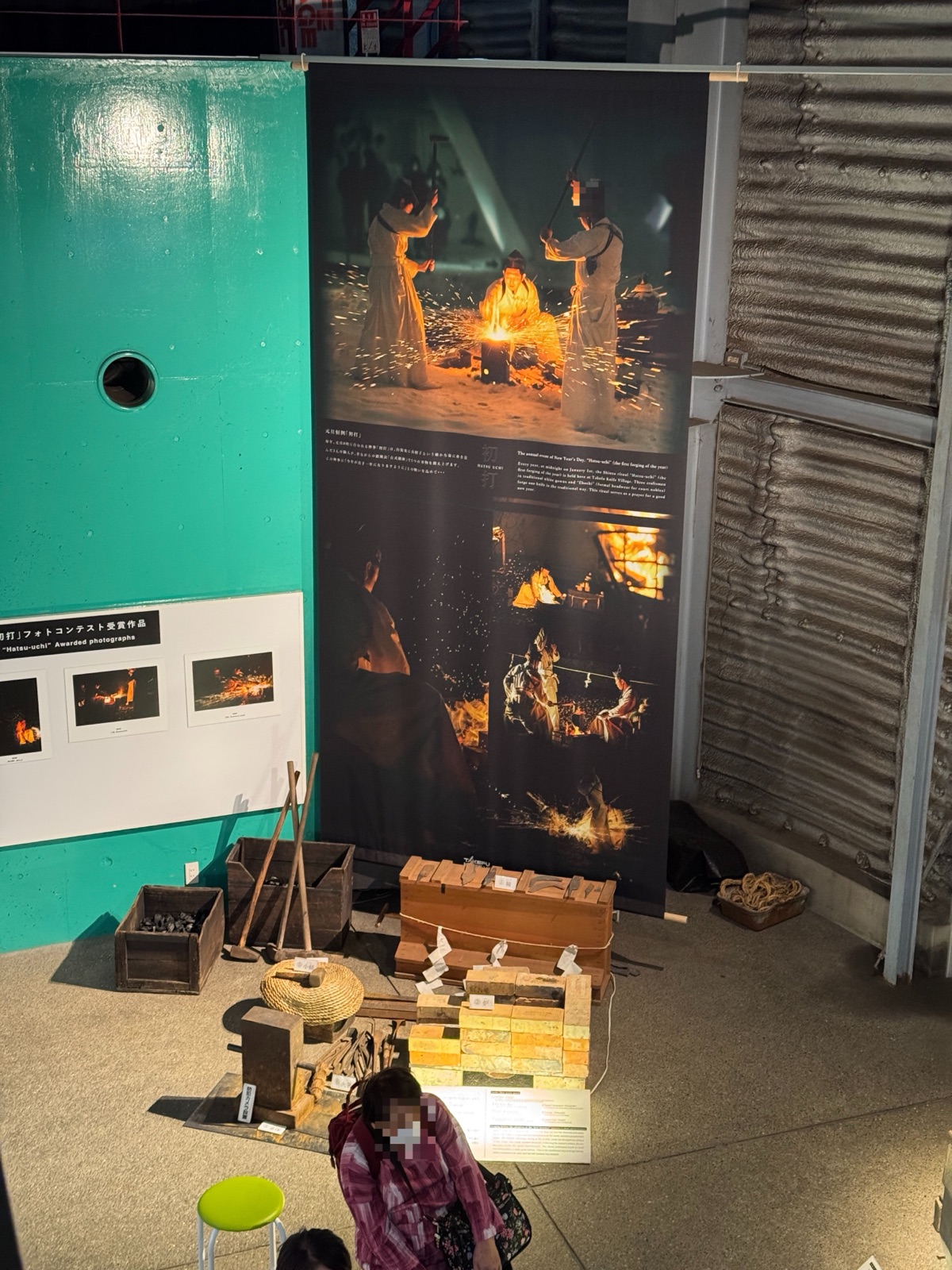
One corner of the museum is about Hatsu-uchi, the “first strike.” According to the village brochure, every year since the co-op was founded, three craftsmen dressed in white forge a single blade at midnight on New Year’s Day as a prayer for a good year. The corner shows large photos of the ritual and prize-winning entries from a Hatsu-uchi photo contest, with old forging tools set out in front.
How the village itself came about
In the 1970s, as farming mechanized, demand for handmade sickles fell; most of the roughly 60 sickle smithies in Echizen are said to have closed, and stainless steel and cheap stamped blades hurt the knife makers too. Ten craftsmen who were then the next generation in the trade decided to fight back. In 1982 they began working with the Fukui-born designer Kazuo Kawasaki, who brought industrial design to a traditional craft; their first 17 new products were shown in Roppongi, Tokyo, in 1983, and in 1986 they exhibited in New York. They then built their own base: Takefu Knife Village was completed in May 1993 and opened its shared workshop to the public. The brochure says the co-op now has 16 certified traditional craftsmen.
If you want to see forging in action
The village’s own English leaflet notes that fewer craftsmen work on weekends. The Echizen Knife Hall of Fame, about 15 minutes by car from Echizen-Takefu Station, lists its own events in its brochure: forging demonstrations, generally in even-numbered months (no booking needed), and hand-sharpening classes, generally in odd-numbered months (booking required). These are Hall of Fame events, not Knife Village events, so check the Hall of Fame’s own schedule before you go.
If you want an Echizen knife but can’t make the trip, you can order one online.
Buying Echizen knives online (Hocho Knife)
Hocho Knife is a Japanese knife shop that ships internationally. We have not used these products ourselves, so we don't rate them. Check prices, stock and shipping on the shop's pages.
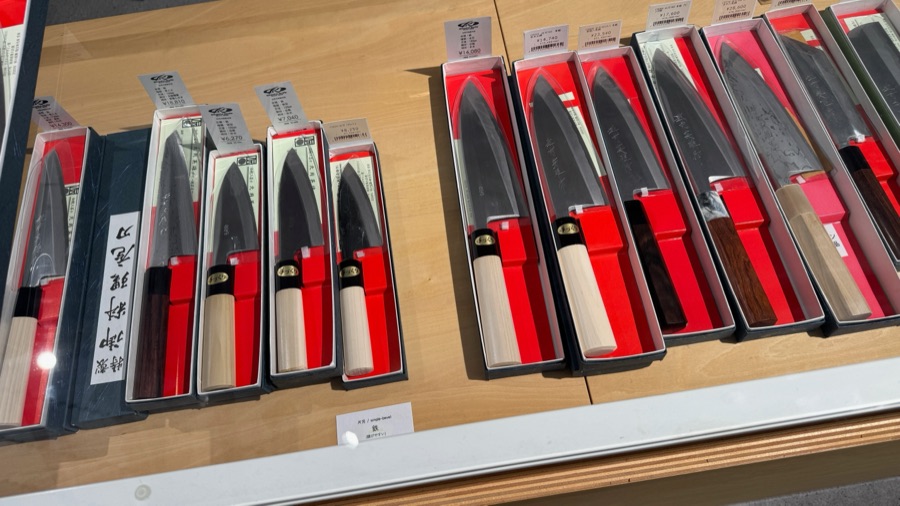
Our photo from the Takefu Knife Village shop, not the item sold online
Hocho Knife
The shop carries knives by Echizen makers including Yu Kurosaki, Takeshi Saji and Yoshimi Kato.
See the knife brands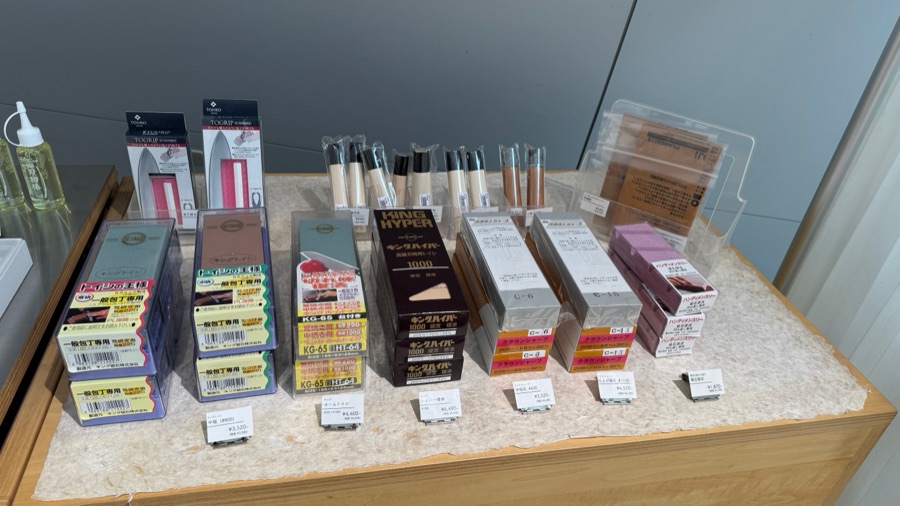
Our photo from the Takefu Knife Village shop, not the item sold online